FLUX
Black Forest Labs' Image and Video Model Family
French AI company whose flagship models ship as open weights and whose API undercuts the American labs. Assistant now called Vibe, not Le Chat. Free tier includes $10 a month of API credit.
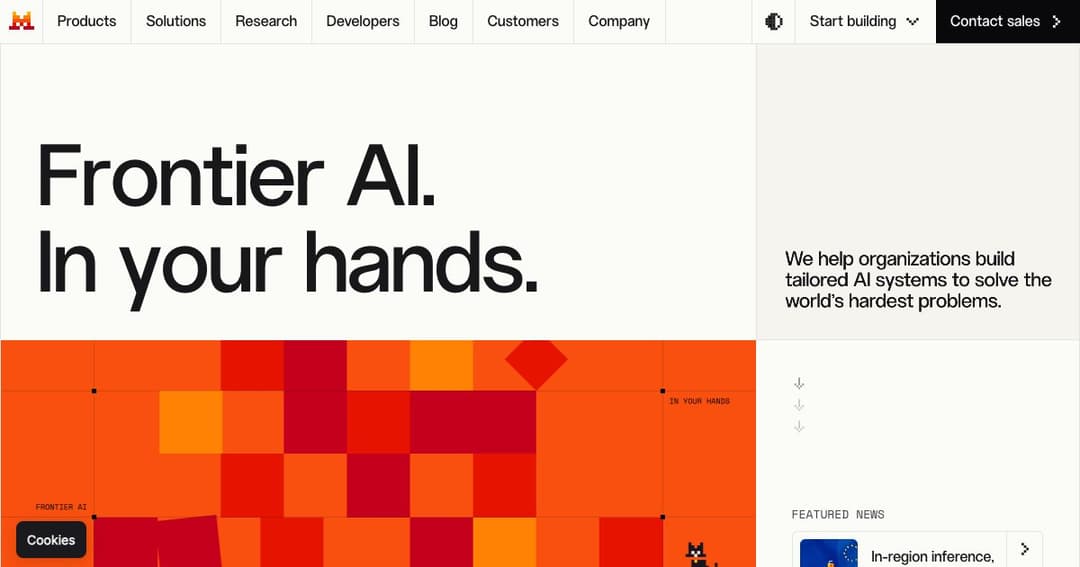
Mistral is a French AI company that builds frontier models and, unusually among labs at that level, publishes the weights for most of them. It sells an assistant, a coding agent, an API and a platform for training your own models — and it is the only European option that credibly competes with the American labs on capability rather than on price alone.
One thing to clear up first, because it makes older articles confusing: the assistant is now called Vibe. The name Le Chat, which is what most people still search for, has gone. The coding agent is Vibe for code, and alongside them sit Studio for building agents and applications, Forge for training and aligning custom models, and an AI Cloud for infrastructure.
The strategic position is what makes Mistral interesting rather than merely competent. Open weights and European jurisdiction are not features — they are the answer to two questions that closed American models cannot answer at all.
Most of Mistral's line-up is marked open, and the small multimodal model is released under Apache 2.0 — a genuinely permissive licence, not a marketing use of the word «open». The flagship is an open-weight general-purpose multimodal model, which is a sentence you cannot write about any comparable model from the largest American labs.
That matters in three concrete situations. You can run the model on your own hardware, so nothing leaves your building. You can fine-tune it on your own material and keep the result. And you are not exposed to a vendor deprecating the model you built on — a risk that stopped being theoretical this year.
Licences differ across the line-up, though, and the labels on the pricing page are not all the same. Check the specific model's terms before you assume you may deploy it commercially — the word «open» is doing different work in different rows.
The assistant: chat, web search, document libraries, image generation, voice mode, canvas, project folders, connectors and scheduled tasks. It does the things you would expect a modern assistant to do, and it does them noticeably fast — speed has been a consistent Mistral characteristic rather than an accident.
Coding agents that run in a terminal, in an IDE, or remotely in the background. There is remote agent observability and a hooks system, which tells you the intended user is a team putting agents into a real workflow rather than an individual asking for snippets.
Studio is where you build, test and run agents and applications against the API, with usage dashboards. Forge is for training, aligning and evaluating custom models. Forge is the part that follows logically from open weights: if you can have the model, you should be able to shape it.
Mistral is cheap, and the structure has a quirk worth catching.
| Model or service | Input | Output | Notes |
|---|---|---|---|
| Flagship general model | $0.50 / 1M tokens | $1.50 / 1M tokens | Open weight, multimodal, multilingual |
| Agentic and coding model | $1.50 / 1M tokens | $7.50 / 1M tokens | Long-horizon tasks, tool calling |
| Small multimodal model | $0.15 / 1M tokens | $0.60 / 1M tokens | Apache 2.0, for cost-sensitive work |
| Document OCR | $4 per 1,000 pages | — | $5 per 1,000 for full document understanding |
| Speech transcription | $0.003 per minute | — | Batch audio |
The quirk: the flagship general model is cheaper than the agentic coding model, five times cheaper on output. Size names do not map to price here. Pick by task — general reasoning and multimodal work on the flagship, long-horizon agentic and coding work on the dearer one, high-volume routine work on the small model — and ignore the intuition that bigger costs more.
Two discounts change the arithmetic substantially. Batch processing halves the price for work that does not need an immediate answer, and cached input tokens cost up to ninety per cent less on repeated prompts. Any high-volume application should be built to use both.
Mistral also resells selected third-party models through the same API, so a shop that standardises on it is not locked to Mistral's own line-up. And there is a separate Enterprise API tier with regional data processing controls, system-level SLAs and higher rate limits, priced at 75 per cent above list — sovereignty is available, and it is not free.
| Plan | Price | What you get |
|---|---|---|
| Free | $0 | Limited messages, searches and coding sessions, image generation, Studio access, $10 a month in API credits, 100+ connectors |
| Pro | $14.99/mo | Around six times the free message allowance, all-day coding in CLI, IDE or web, $30 a month in API credits, chat and email support |
| Team | $24.99/user/mo | Everything in Pro plus up to 30GB storage per user, domain verification, data export |
| Enterprise | By request | Private deployments, custom models, agents and workflows, audit logs, SAML SSO, white label |
Pro is the cheapest of the serious assistants — a third less than the standard twenty dollars charged by the American competition — and it includes thirty dollars of API credit, which for many people covers the subscription on its own. There is a student plan too.
Note that the free tier is not a crippled demo: it includes ten dollars of monthly API credit and access to Studio. If you want to evaluate the models properly before writing any code, this is a more generous starting point than most.
Training opt-out is available on every tier, which is worth saying because it is not universal in this market.
The clearest case by a distance. When the question is not «which model is best» but «which model may we legally use», a European company offering both regional data processing and downloadable weights answers it in a way nobody in California can.
Defence, healthcare, finance, government — or simply a business that has decided its data does not leave its own machines. Open weights turn an impossible requirement into an infrastructure decision.
The flagship at fifty cents per million input tokens is a fraction of what the American frontier models charge, and batch and cache discounts stack on top. For high-volume work where the very best reasoning is not required, the economics are hard to argue with.
Per-page OCR and per-minute transcription are priced for volume, and both are strong. If your problem is a warehouse of PDFs or a decade of recordings, this is a specific, well-priced answer rather than a general model bent to the task.
It is now called Vibe. Same idea, current name — the assistant on web and mobile, with a separate Vibe for code for agentic development in the terminal and IDE.
There is a free plan with limited messages, searches and coding sessions, plus image generation, access to Studio and ten dollars a month of API credit. Pro is $14.99 a month and includes thirty dollars of credit.
Most of the line-up is published as open weights, and the small multimodal model is Apache 2.0. Licences vary by model, so read the terms for the specific one you intend to deploy rather than assuming the whole family is permissive.
It undercuts the American frontier labs substantially — the flagship costs fifty cents per million input tokens and a dollar fifty output. Batch processing halves that again, and cached input can cut input cost by up to ninety per cent.
Training opt-out is offered across the plans. For guaranteed regional data processing and contractual SLAs you need the Enterprise API tier, which is priced 75 per cent above the standard list.
On raw capability at the very top end, the American models still generally lead. Mistral wins on price, on speed, on being able to take the weights with you, and on being subject to European law. Which of those matters is a question about your organisation, not about benchmarks.
Mistral is the serious answer for anyone who cannot or will not depend on a closed American model. It is fast, it is cheap, the assistant is a third less than its competitors, and the weights are downloadable — which means the worst thing a vendor can do to you, discontinue the product, is a problem you can engineer around.
Start on the free tier, which includes real API credit, and pick models by task rather than by size, because the pricing does not reward the intuition. If data residency is a requirement, budget for the Enterprise tier early — that is where sovereignty is actually sold.