Ollama
Run Open AI Models on Your Own Machine
FreeAPI
A single OpenAI-compatible endpoint reaching 500+ models from 80+ providers, with automatic failover. No markup on inference — the fee is on buying credits.
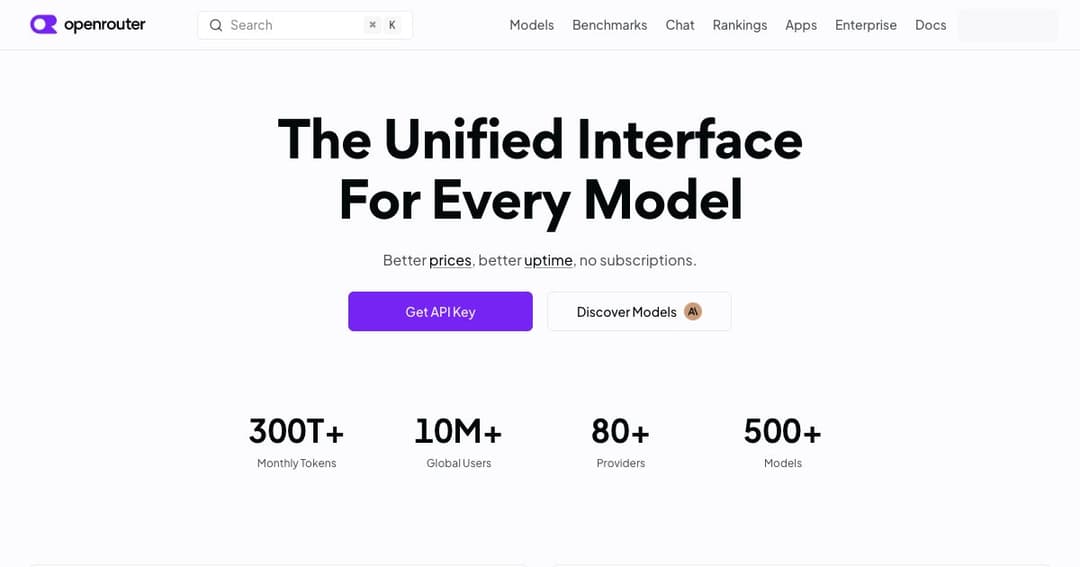
OpenRouter is a switchboard. One API key and one OpenAI-compatible endpoint reach more than 500 models from over 80 providers, and switching between them is a change to a string in your request rather than a new account, a new SDK and a new billing relationship.
The problem it solves is not technical difficulty — calling any single provider is easy. The problem is commitment. Choosing a model in 2026 means choosing a vendor, and the best model for your particular job changes roughly every quarter while your integration does not. OpenRouter turns that decision from architecture into configuration.
It has become large enough that this matters as infrastructure rather than convenience: the company reports over 300 trillion tokens a month across more than 10 million users. That volume is itself the argument — a great many teams decided they would rather not pick a side.
The API is fully OpenAI-compatible, so existing code usually needs a base URL, a key and a model name. From there the model identifier carries the provider — you are naming what you want rather than who you buy it from, and the routing happens on their side.
This makes comparison genuinely cheap. Running the same prompt against six models from four companies is a loop rather than a project, which is the sort of evaluation everyone claims to do and almost nobody does, because until recently it meant four sign-ups and four invoices.
When a provider goes down, requests fall back to another one serving the same model. Anyone who has watched a single upstream outage take their product with it will understand why this is worth more than the model catalogue.
Many open-weight models are served by several providers at different prices and speeds, so routing can also select on cost or latency rather than only on availability. Requests run at the edge to keep the added hop small, which is the obvious objection to putting an intermediary in the path.
You can set fine-grained data policies so prompts only reach providers you have approved — a real requirement once an aggregator sits between you and dozens of companies with different retention terms. Bring Your Own Key lets you keep direct commercial relationships and still route everything through one integration.
BYOK is where the economics get specific. Up to $25,000 of monthly usage there is no fee; above that OpenRouter takes 5% of what the equivalent usage would have cost through them. Enterprise raises the free allowance to $200,000 a month.
The important number is the one that is not there. OpenRouter states it passes through provider pricing without markup — you pay the same per-token rate you would pay the provider directly. The business model sits elsewhere.
| What | Cost | Notes |
|---|---|---|
| Inference | Provider's own rate | No markup, per the company's documentation |
| Subscription | None | Credits, not a monthly plan |
| Buying credits by card | 5.5%, minimum $0.80 | Stripe processing |
| Buying credits by crypto | 5% | Via Coinbase |
| BYOK up to $25,000/month | Free | Pay-as-you-go tier |
| BYOK above that | 5% | Of equivalent OpenRouter cost |
| Enterprise BYOK allowance | $200,000/month | Overage at 5% |
For anyone spending modestly, the effective cost of the abstraction is the 5,5% card fee on topping up — a few dollars on a hundred. That is cheap for never having to migrate again, and it is a real number rather than zero, which some write-ups get wrong by quoting only the no-markup line.
Buy credits in larger increments if the $0.80 minimum matters to you: on a $10 top-up it is the whole fee, and on $99 it is not.
If a model outage means your application stops working, failover across providers is the entire reason to be here. It converts a dependency you cannot control into one you can route around.
Evaluation is the natural first use. Point the same workload at a dozen candidates, look at cost and quality together, and make the decision on evidence instead of on whichever launch you read about most recently.
Classification wants something small and cheap; the final draft wants something strong. Routing per request rather than per application is how that stops being an architectural argument and starts being a line of code.
It is a legitimate reason. Building against one provider's API is a bet on that company's pricing, availability and roadmap. Building against an aggregator is a bet on a smaller company, which is a different risk — but a more reversible one.
Not on inference — the company states it passes provider pricing through without markup. You pay a processing fee when buying credits, 5,5% by card or 5% by crypto, so the total is slightly higher than direct unless you are using your own keys within the free allowance.
Usually not. The API is OpenAI-compatible, so it is generally a base URL, a key and a model name. Anything relying on provider-specific extensions needs checking.
More than 500 from over 80 providers, spanning commercial frontier models and open weights. Several open models are offered by multiple providers at different prices, which is what makes cost-based routing possible.
Yes. Data policies let you restrict traffic to providers you trust, and they are worth configuring deliberately rather than accepting whatever the default routing chooses.
Requests fall back to another provider serving the same model. This is the feature most people underrate when comparing OpenRouter to going direct, and the one they appreciate the first time an upstream API has a bad afternoon.
No. You buy credits and spend them. There is no monthly minimum, which suits bursty workloads and experiments far better than a plan does.
OpenRouter sells optionality. The models are the same models, at the same per-token prices, and what you are actually buying is the ability to change your mind — about which provider, which price point, which quality tier — without touching your integration.
For most teams building on language models that is worth more than the few percent it costs in credit fees. The honest caveat is that removing one dependency creates another, smaller one, and that the newest provider features will always reach you slightly late. Neither is a reason to avoid it; both are reasons to know what you are choosing.