Human
AI Marketing Software for Email & SEO Personalization
Free
Research competitors, generate ad creative and grade performance in one place. Built for agencies and brands running paid social at volume, from $129 a month.
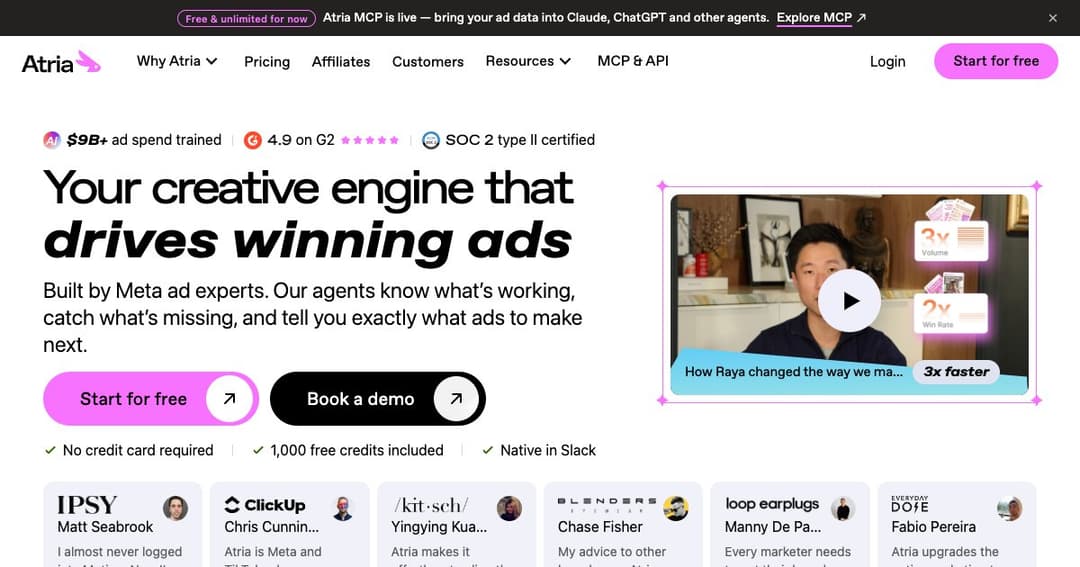
Atria is a platform for making Meta and TikTok ads work harder. It sits across the whole loop — researching what competitors are running, writing and generating the creative, pushing it live, and grading what came back — rather than doing one slice of it and handing you off to another tool.
At the centre is an AI agent the company calls Raya, which it says is trained on more than $9 billion of real ad spend. That claim is the whole pitch and it is worth reading carefully: the value is not that a model can write ad copy — everything can write ad copy now — but that it has seen which copy actually performed and which quietly burned budget.
The company reports more than 20,000 teams using it and holds SOC 2 Type II certification. It is built for two audiences and only two: agencies running client ad accounts, and brands running their own at enough volume that creative production is a bottleneck.
The starting point is other people's ads. Atria pulls apart what competitors are running — the hooks, the personas being targeted, the landing pages behind them — and turns that into angles you can use. It also mines customer reviews for language, which is where a lot of the best ad copy actually comes from: your customers already wrote it, in their own words, on a review site.
You can follow specific brands and benchmark against ads that are demonstrably working. This is the part that most creative tools skip, and it is the reason the output tends to be better than a general model given a blank prompt.
Scripts, copy and images are generated with the performance history informing them rather than as a standalone creative exercise. Existing ads can be cloned and iterated, which is how paid social actually works day to day — you rarely start from nothing, you take the ad that worked and change one variable.
Everything is auto-tagged by hook, persona, unique selling point and format. That tagging is duller than the generation and probably more valuable: it is what lets you answer which hook type wins for this audience, instead of having a folder of 3,000 files nobody can query.
Creative uploads to Meta in bulk with one click, winners scale automatically and underperformers pause. Slack integration means the alerts land where the team already is rather than in a dashboard someone has to remember to open.
After the fact, ads are graded with specific recommendations, and the platform flags decline before you notice it in the numbers. The loop closes here: what the grading learns feeds the next round of generation.
Atria exposes an MCP server, so your ad data can be queried from Claude, ChatGPT or whatever agent you already work in. Both MCP and API usage are currently uncapped on every tier — the pricing page says unlimited for now, and that phrasing is worth taking at face value rather than as a permanent commitment.
For anyone who already runs analysis through an assistant, this matters more than another dashboard would. It means the performance history is available where you are asking questions, instead of behind a login you have to remember to open.
Pricing is per workspace with seats included, and annual billing takes 20% off. The prices below are the annual rate; monthly billing costs the higher figure.
| Plan | Annual | Monthly | AI credits | Seats | Ad accounts | Ad spend analysed |
|---|---|---|---|---|---|---|
| Core | $129/mo | $159/mo | 4,000/mo | 5 | 5 | $500K/mo |
| Plus | $479/mo | $599/mo | 10,000/mo | 8 | 10 | $1M/mo |
| Business | $959/mo | $1,199/mo | 25,000/mo | 15 | Unlimited | Unlimited |
| Enterprise | Custom | Custom | Custom | Custom | Custom | Custom |
You can start without a card: signup includes 1,000 free AI credits, which is enough to run the research and generate a first batch of creative before deciding. Extra seats are $20 a month on every tier. Asset storage runs from 5 GB on Core to 5 TB on Business, and the number of brands you can follow goes 50, 100, 200 — with AI insights on the followed brands only from Plus upward.
The number that will actually decide your plan is the ad spend ceiling, not the seat count. Core analyses up to $500,000 a month, which sounds enormous until you are an agency with a dozen clients. Work out your combined managed spend first and read the tiers backwards from there.
This is the intended buyer and the pricing says so. Multiple client accounts, seats for a team, and research that can be reused across clients in the same vertical — the economics work when the platform fee is spread across retainers.
If your paid social strategy is to launch many variants and let the data choose, the bottleneck is production, not ideas. Bulk generation with auto-tagging and one-click upload is aimed exactly at that constraint.
Anyone with thousands of past creatives and no way to search them by what actually made them work. The tagging turns a storage folder into something you can ask questions of, which is worth more than most people expect until they try it.
Research, generation, launch and grading in one place means the learning does not fall out between tools. If your current stack is a competitor-spy tool plus a design tool plus a spreadsheet, this replaces the seams where information gets lost.
There is a free start rather than a free plan: signup needs no card and includes 1,000 AI credits. After those run out, paid plans begin at $129 a month billed annually, or $159 billed monthly.
Meta and TikTok, with direct integrations for both, plus Slack for team alerts. Other ad networks are not covered, which matters if your spend is spread wider.
Credits meter the generative work — scripts, copy, images, analysis. Core includes 4,000 a month and Business 25,000. Consumption depends heavily on how much image generation you do, so watch the first month closely before committing to a tier.
Add up the monthly ad spend across all client accounts you would connect. Under $500,000 with five accounts fits Core; past either limit you are on Plus, and unlimited accounts only arrive on Business.
No, and treating it that way is how you get generic ads. It removes the production bottleneck between having an angle and having fifty variants to test. Deciding which angles are worth testing is still the human part.
The company holds SOC 2 Type II certification, which is the certification enterprise procurement usually asks for. As always, the specifics of what is retained and for how long belong in your own review rather than in a summary.
Atria is a paid social platform for people whose problem is throughput. Its real advantage is not the generation — that commodity arrived a while ago — but that research, creative, launch and grading sit in one loop, so what you learn from a campaign shapes the next one automatically.
Whether it belongs in your stack is mostly a question of scale. An agency with a dozen accounts will get the platform fee back quickly; a single brand spending modestly on Meta will not. Work out your combined managed spend, check it against the tier ceilings, and be honest about how much creative you actually ship in a month.