Charley
Essay Writing Assistant for Students
Free
Give it an objective and it researches, builds and delivers — slides, websites, analysis, games — while you do something else. Credit-based from $20 a month, with a corporate change worth knowing about.
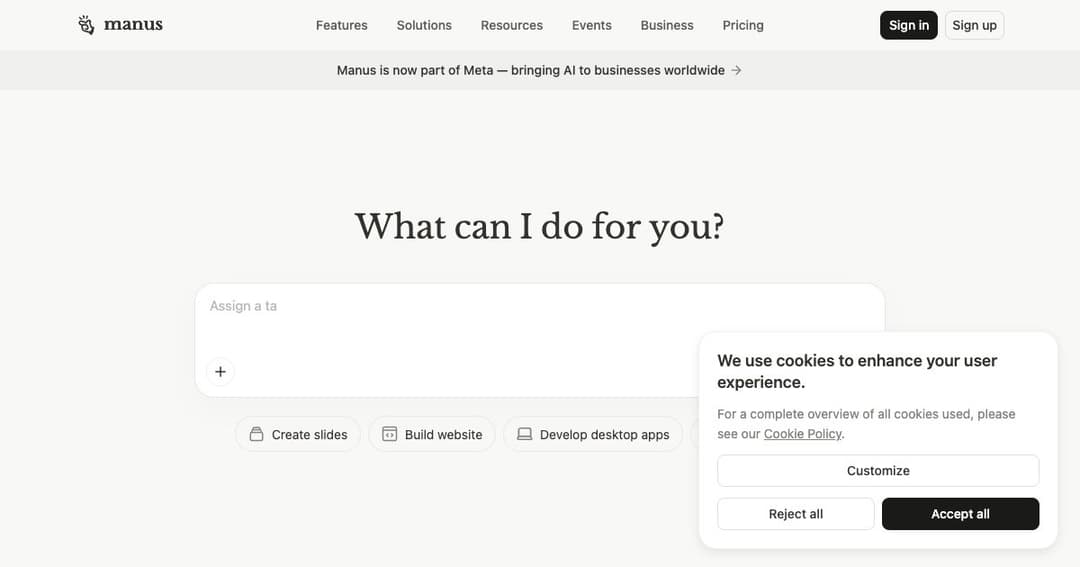
Manus is currently carrying a notice on its own site stating that it will soon resume operating as an independent company, and that action may be required on your account. If you already use it, log in and check what is being asked of you before anything else on this page matters.
Corporate restructuring is not usually catalogue material, but a message telling existing users to take action is. Read it in your own account rather than in an article, and export anything you would be unhappy to lose.
Manus is a general-purpose AI agent. You give it an objective rather than an instruction — research this market, build a site for this product, analyse these numbers and make me a deck — and it goes away and does the whole thing, planning its own steps and using a browser, a terminal and files along the way.
The distinction from a chat assistant is not subtle. A chatbot answers and waits. An agent works while you close the tab, and comes back with a deliverable: a finished set of slides, a deployed website, a report with sources. The unit of interaction is a task completed rather than a message answered.
That was startling when it launched and is now the shape of a whole category. Manus remains one of the more capable general agents, and it has grown outward into a suite — design, slides, image and music generation, a browser operator, a Slack integration and an API.
Not a summary of the first ten search results. It reads sources, follows leads, cross-checks and returns something structured with its working visible. For competitive analysis, market scans and due diligence, the difference between this and a chat answer is measured in hours.
The scaling feature: instead of one agent working sequentially, the task is spread across many running in parallel. It is what makes «look at all two hundred of these» a realistic instruction rather than an overnight job, and it is metered accordingly.
Slides you can present, websites that are actually deployed, spreadsheets with the analysis already done, small games and interactive pages. The output is a file or a URL rather than a block of text you then have to turn into something.
A browser operator lets it click through interfaces the way a person does, and the top tier includes a cloud machine of its own. This is what lets it reach systems that have no API, which is most of them.
| Plan | Price | Credits | What it is for |
|---|---|---|---|
| Standard | $20/mo | 4,000 a month, plus 300 refreshing daily | Everyday research, standard sites and slides |
| Customizable | $40/mo | 8,000 a month, plus 300 daily | Self-set usage for changing workloads |
| Extended | $200/mo | 40,000 a month, plus 300 daily | Large-scale tasks, batch production, its own cloud machine |
| Team | By request | Pooled across seats | Shared credits, SSO, access controls, usage analytics |
Annual billing saves about seventeen per cent. Every paid tier includes twenty concurrent tasks and twenty scheduled ones, which is unusually generous — the plans differ on how much work you can do, not on how many things you can run at once.
The published pricing page lists these paid tiers and no free plan. Signing up costs nothing, but do not plan around a free allowance you have not confirmed for your own account.
The number that decides everything is credit consumption, and it is genuinely hard to predict. A short question costs little; an agent that spends forty minutes browsing, retrying and rebuilding costs a great deal. The gap between the twenty-dollar tier and the two-hundred-dollar one is tenfold in credits, and people who exhaust the cheapest plan in a week are not doing anything unusual — they are running the agent as intended.
The clearest case. Work that is genuinely time-consuming but not conceptually difficult — gathering, comparing, tabulating, sourcing — is exactly what an agent does well and exactly what costs a person a day.
A deck with real research behind it, produced overnight. The value is not that the output is final — it rarely is — but that the first eighty per cent arrives before the meeting rather than after it.
A landing page, a data analysis, a set of slides, when there is no designer, no analyst and no developer. It will not match a professional, and for a company of four that is not the comparison being made.
Wide Research plus scheduled tasks turns «check these two hundred things every Monday» into something that happens without anyone remembering to do it.
The published plans start at twenty dollars a month. Creating an account costs nothing, but no free usage tier is listed on the pricing page — confirm what your own account includes rather than assuming.
The work the agent does: browsing, reasoning, generating, retrying. Long autonomous tasks consume far more than short questions, and failed attempts still cost. Budget by task complexity, not by number of requests.
Those answer you; Manus goes and does the task. The general assistants have since grown agentic modes of their own, so the gap is narrower than it was — but Manus is still built around finishing work unattended rather than around conversation.
Research reports with sources, presentation decks, deployed websites, data analysis, images, music, small games and interactive pages. The output is a deliverable rather than a description of one.
Twenty concurrent and twenty scheduled on every paid tier. The plans differ by credit allowance rather than by concurrency, which is a more sensible design than most.
Yes, with credits pooled across seats, single sign-on, access controls and usage analytics. Pooling matters here more than usual, because individual credit consumption varies so widely.
Manus was the product that made autonomous agents feel real rather than promised, and it still does the thing well: hand it a genuinely tedious multi-step job and get a finished artefact back. For research, analysis and first drafts of things that would otherwise take a day, it earns its subscription quickly.
Two cautions before you commit. Credits vanish faster than intuition suggests, so start on the entry plan and watch what a real task costs. And there is a live notice about the company's structure asking users to take action — deal with that first, and keep copies of anything important.