Veo
Google's Video Model, With Sound Built In
No longer just Dream Machine — Luma is now a workspace with agents that runs its own Ray models alongside Kling, Seedance and others. The free tier is gone; entry is $30 a month.
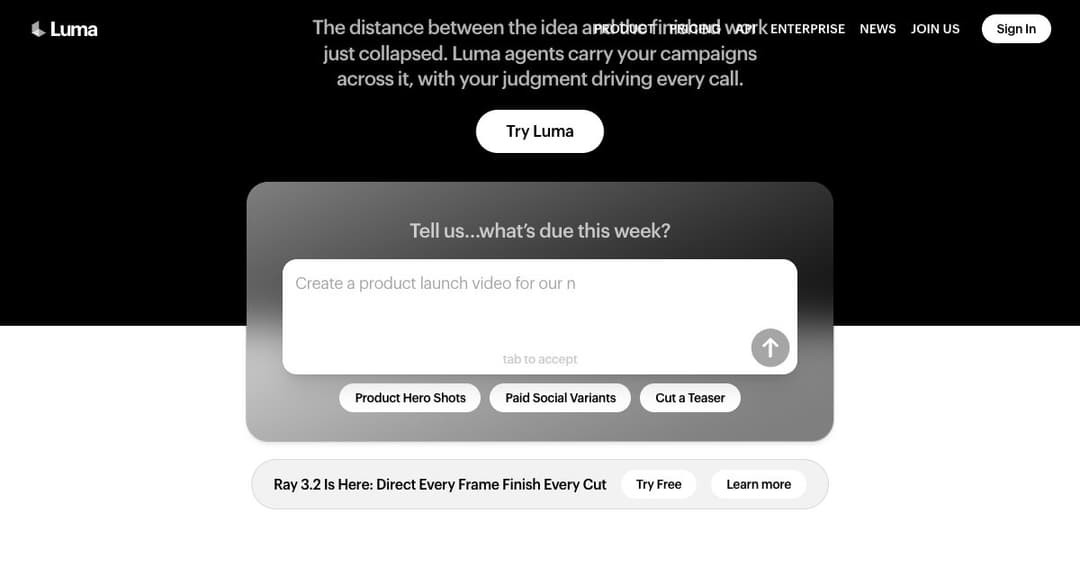
If you remember Luma as Dream Machine — the video generator with a free tier you could play with — both halves of that memory are now out of date.
First, there is no free plan. The cheapest way in is thirty dollars a month. Second, and more interesting, Luma stopped being a generator and became a workspace: it now runs its own models alongside its competitors', in one interface, on one credit balance.
Luma positions itself as creative agents for creative professionals — a place where planning, generating, iterating and refining happen together, with context carried between them rather than lost every time you open a new tab.
The practical shape is a workspace. Agents advance work across stages; context stays shared between formats; teams and agents operate in parallel on the same material. There are reusable skills for turning a workflow you repeat into something you invoke, shared team workspaces with pooled credits, and export settings aimed at production rather than at social posts.
That is a different product from the one that made the company's name, and it is aimed at a different customer: studios and creative teams rather than people trying generative video for the first time. The removal of the free tier is not an accident — it is the same decision expressed in pricing.
This is the genuinely notable part. Alongside Luma's own Ray models, the platform serves video and image models from several other labs — including the ones a Luma customer might otherwise leave for. One subscription, one credit balance, and a model selector containing the competition.
For a working professional that is a real convenience. Different models are good at different things, and switching between four separate subscriptions with four separate credit systems is a tax on getting work done. The trade is that you are paying Luma's rate for access you could buy directly, in exchange for not managing four accounts.
It is also a candid admission about the market. A company that spent a year selling its own model now sells the workspace and treats the model as interchangeable — which is probably the right read of where the value is settling.
Everything is billed in credits per second of video, and the cost depends on which model you pick, at what resolution, with or without audio. The range is not a matter of a few per cent.
| Example | Resolution | Cost |
|---|---|---|
| Luma's efficient model, draft | draft | 4 credits/sec |
| Luma's efficient model | 720p | 20 credits/sec |
| Luma's flagship model | 720p | 100 credits per 5 sec |
| Luma's flagship model | 1080p | 400 credits per 5 sec |
| A third-party model with audio | 1080p | 240 credits/sec |
| A third-party model with audio | 4K | 959 credits/sec |
From four credits a second to over nine hundred is a spread of more than two hundred times. Picking a model without checking its rate is the single most expensive mistake available here, and it is very easy to make because the selector does not feel like a pricing decision.
Translate that into the entry plan and it becomes concrete. Ten thousand credits is roughly eight minutes of 720p video on Luma's flagship model, about two minutes at 1080p, or around ten seconds on the most expensive third-party option at 4K. Same plan, same month.
| Plan | Monthly | Billed yearly | Credits | Notes |
|---|---|---|---|---|
| Plus | $30 | $25/mo ($300/yr) | 10,000 | Luma and third-party models, guest collaborators, commercial use |
| Pro | $90 | $75/mo ($900/yr) | 40,000 | Four times the agent usage |
| Ultra | $300 | $250/mo ($3,000/yr) | 150,000 | Fifteen times the agent usage |
| Team | By request | — | Shared pool | Member management, projects, analytics, SSO |
| Enterprise | By request | — | Custom | Commitments, training, custom fine-tuning |
Yearly billing saves about a sixth. Commercial use is included from the entry plan, which is the right way round.
Note that agent usage is a separate axis from credits: the higher tiers advertise four and fifteen times the agent capacity rather than simply more generation. If the agents are what you came for, that multiplier matters more than the credit count.
The audience the product now targets. Shared workspaces, pooled credits, projects, analytics and single sign-on are the things that matter when several people work on the same campaign and somebody has to account for the spend.
If your work already involves choosing between three or four generators depending on the shot, consolidating them behind one subscription and one balance is a genuine simplification.
The credit ladder runs to a hundred and fifty thousand a month, which is not a hobbyist number. Combined with production-grade export settings, this is built for people shipping finished work rather than experimenting.
Turning a sequence you run every week into a reusable skill is the sort of feature that only exists once a tool has real professional users. If your process is stable, this is where the time saving compounds.
No. The published plans start at thirty dollars a month, or twenty-five if you pay for a year. The free Dream Machine tier people remember is no longer part of the offering.
Luma's own Ray family plus video and image models from several other labs, all inside the same workspace and drawing on the same credit balance. The line-up changes as models are added.
It depends entirely on the model and resolution. On the entry plan, ten thousand credits is roughly eight minutes at 720p on Luma's flagship, about two minutes at 1080p, and a matter of seconds on the most expensive high-resolution third-party option.
Commercial use is listed from the entry plan upward. As always, read the current terms before releasing anything you are being paid for.
Agents that carry work across stages of a project — planning, generating, refining — with shared context rather than isolated prompts. The higher plans buy four and fifteen times the agent capacity, which is priced separately from generation credits.
If you switch between several models regularly and work with other people, the workspace and pooled credits are worth the markup. If you use one model occasionally and work alone, buying that model directly will cost you less.
Luma made a clear-eyed bet: that the model is becoming a commodity and the workspace around it is where the value sits. So it runs its competitors' models next to its own, sells agents and shared context and team management, and prices for professionals rather than for the curious.
That makes it a strong choice for a studio and a poor one for a first experiment. Check the credit rate of every model before you use it, because the spread between cheapest and dearest is wide enough to consume a month's allowance in an afternoon. And if you came here remembering a free tier, it is not there any more.