Yuma
AI Customer Service Automation for E-commerce Growth
Live chat, ticketing and an AI agent that resolves about two thirds of enquiries on its own. Free tier for 50 conversations a month; Lyro is a separate add-on.
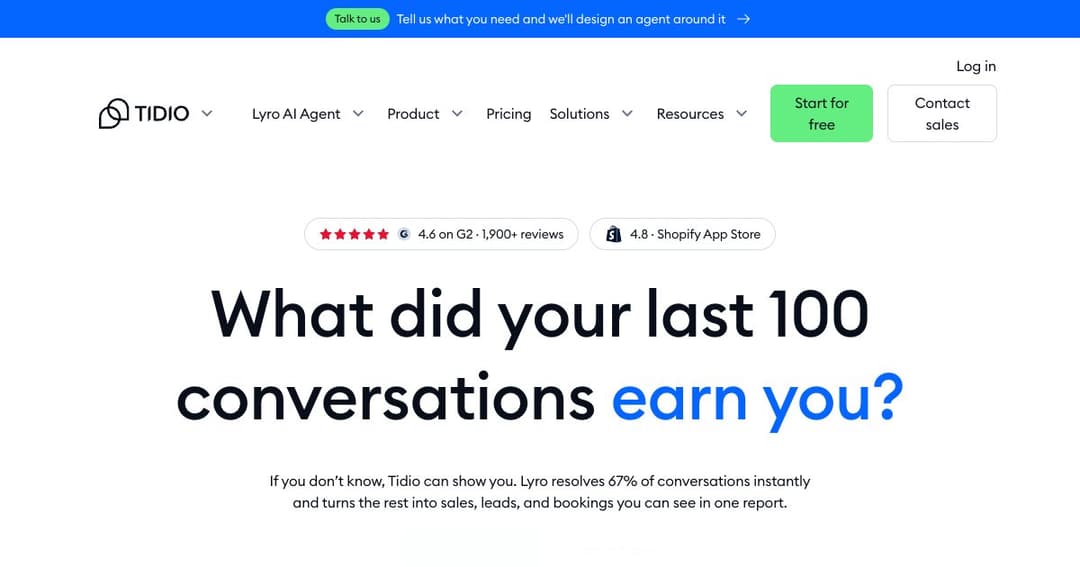
Tidio is a customer service platform built around three things that usually come from three vendors: live chat, a ticketing system, and an AI agent called Lyro that answers customers without a human involved. The company says more than 300,000 businesses use it, most of them small and mid-sized shops rather than enterprises.
Lyro is the part worth paying attention to. It reads your existing help content — scraping your support pages rather than waiting for you to write training data — and answers from that. Tidio puts its average resolution rate at around 67%, meaning roughly two enquiries in three never reach a person.
A detail most write-ups miss: Lyro runs on Claude rather than on OpenAI's models. That is unusual enough to note, and it matters in practice because the failure modes differ — Claude tends to decline rather than invent when it does not know, which is the behaviour you want from something talking to your customers unsupervised.
You point Lyro at your support content and it builds its knowledge base by scraping what is already there. No intent trees, no sample utterances, none of the setup that made older chatbots a project rather than a purchase. In practice this is the difference between going live this afternoon and going live next quarter.
The corollary is that the quality of your answers is the quality of your help centre. If your documentation is thin or out of date, Lyro inherits that, and no amount of model quality compensates. Tidying the help centre first is the highest-leverage hour you can spend before switching it on.
When a question falls outside what Lyro knows, it creates a ticket rather than guessing. Escalation rules are configurable and a human can take over at any point in a conversation.
This is the mechanism that decides whether customers tolerate an AI agent or resent it. An agent that hands over cleanly is a filter; one that loops while the customer types agent in capital letters is a reason to switch supplier. Test this path deliberately before you launch, because it is the one that generates complaints.
Tidio integrates with more than twenty platforms including Zendesk, Intercom and Salesforce, so Lyro can be added to an existing helpdesk rather than replacing it. For anyone already invested in a support stack, that removes the migration argument entirely — you are buying an agent, not a new system of record.
This is where Tidio needs careful reading, because there are two separate meters and people routinely confuse them. Billable conversations cover the platform. Lyro conversations are counted separately and sold as an add-on. A cheap base plan with heavy AI use is not a cheap bill.
| Plan | Monthly | Annual | Billable conversations | Notes |
|---|---|---|---|---|
| Free | $0 | $0 | 50/month | 10 seats |
| Starter | $29 | $24.17 | 100/month | 50 Lyro conversations, one-off |
| Growth | from $59 | from $49.17 | from 250/month | Advanced analytics, macros |
| Plus | from $300 | — | Custom | Plus usage; dedicated success manager |
| Premium | Custom | — | Custom | From 3,000 Lyro conversations/month |
| Add-on | From | Includes |
|---|---|---|
| Lyro AI Agent | $32.50/month | From 50 Lyro conversations a month |
| Flows | $24.17/month | From 2,000 visitors reached a month |
Annual billing works out at $290 for Starter and $590 for Growth — roughly two months free. The Premium tier is the only one that comes with a guaranteed 50% Lyro resolution rate written into the plan, which is a meaningful commitment and priced accordingly.
The 50 Lyro conversations on Starter are a lifetime allowance rather than monthly. They exist to let you see the agent work on your own content before committing to the add-on, and they run out faster than people expect.
Where is my order, do you ship here, what is the return policy. These are answerable from documentation, they arrive constantly, and they are exactly what a 67% resolution rate is made of. Ecommerce is the core market and it shows in the product.
The free tier gives ten seats and 50 conversations a month, which is genuinely usable for a small shop. Growing into paid tiers is gradual rather than a cliff, and that suits businesses whose support volume is unpredictable.
The Zendesk, Intercom and Salesforce integrations mean you can add an AI layer without a migration project. For anyone who has already survived one helpdesk migration, this is the argument that matters most.
Because Lyro learns from your documentation, existing well-maintained help content converts directly into agent quality. If you have already done that work, this is the tool that finally pays you back for it.
There is a genuine free plan: 50 billable conversations a month and 10 seats, with no time limit. It covers live chat rather than AI — Lyro is charged separately once the introductory allowance is used.
It is a conversation your team is involved in during the billing period, and it is the meter the platform plans are sized around. Lyro conversations are counted separately, which is the single most important thing to understand before estimating a bill.
Claude, from Anthropic, rather than OpenAI's models. Tidio states this openly, and it is a reasonable choice for unsupervised customer contact where declining to answer is safer than improvising.
Almost none in the traditional sense. Lyro scrapes your support content and uses it as its knowledge base, so setup is a matter of pointing it at the right pages rather than building intent models.
It creates a ticket for a human rather than guessing, and your escalation rules decide when that happens. A human can also take over mid-conversation at any point.
Yes. Tidio integrates with more than twenty platforms including both, so Lyro can be layered onto your current helpdesk instead of replacing it.
Tidio is one of the more honest AI support products on the market: it tells you which model it runs on, publishes a resolution rate that is plausible rather than flattering, and will sit on top of the helpdesk you already have instead of demanding a migration.
Budget for it properly, though. The base plan price is not the price of running an AI agent, and the two separate meters are where the surprise lives. Tidy your help centre first, test the handoff path hard, and the 67% figure becomes something you might actually hit.