Dify
Open-Source Platform for Building LLM Applications
Free
Drag-and-drop builder for agents, RAG pipelines and MCP servers, with Python under every component. Genuinely free under MIT — but the managed cloud closed in 2026, so you host it yourself.
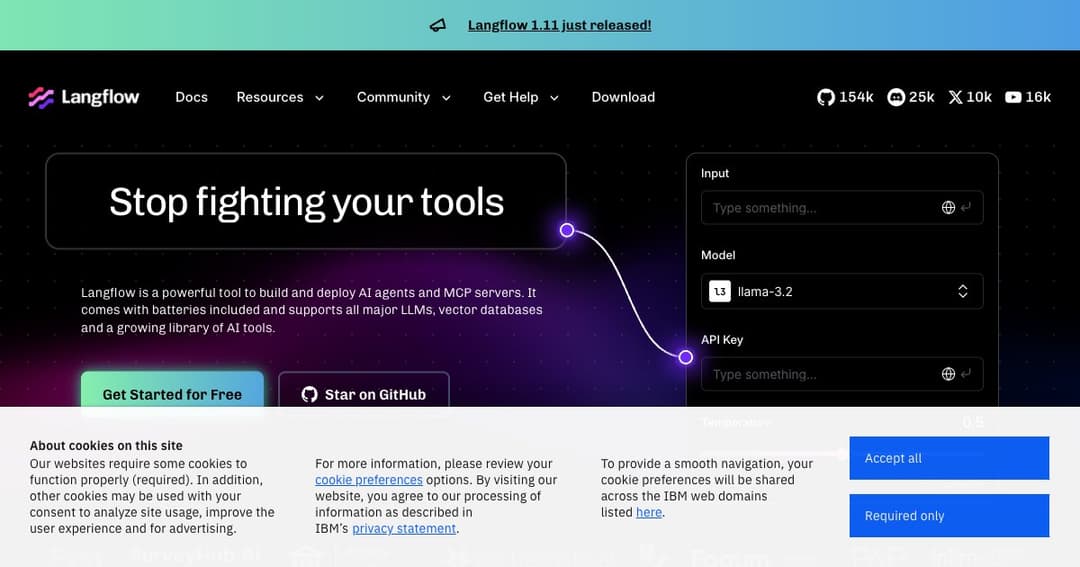
Langflow is a visual builder for AI applications. You drag components onto a canvas — a model, a retriever, a tool, a condition — wire them together, and the result runs as an agent, a retrieval pipeline or an MCP server that other AI assistants can call.
It is one of the most-starred AI projects on GitHub, with well over a hundred thousand stars, and the reason is not the canvas. Plenty of tools have a canvas. The reason is what sits underneath it: every component is Python you can open and edit. The visual layer is a convenience, not a cage.
It is also released under the MIT licence — the real thing, not a modified one with commercial carve-outs. In a category where «open source» increasingly means «open with conditions», that is worth stating plainly.
The managed hosting service that used to run Langflow for you was deprecated in March 2026 and shut down the following month. The open-source project continues and is actively maintained — it now sits inside IBM, which acquired the company behind it — but the practical consequence is that Langflow is a self-hosted product.
You install it yourself, either as a desktop application or with a package manager or container on your own infrastructure. Some marketing copy still refers to a cloud, so verify what is actually on offer before planning around it rather than assuming a hosted option exists.
A single agent with access to tools, or a fleet of them, assembled from components rather than written from scratch. Because every component can also be exposed as a tool to an agent, composition works in both directions — a flow you built can become something another agent calls.
Langflow will publish what you build as an MCP server, which means an AI assistant you already use can call it. This is a genuinely current capability and a good reason to look here specifically: building the connective tissue between your systems and an assistant is otherwise a small engineering project each time.
Hundreds of prebuilt integrations covering model providers, vector stores and data sources — the usual model APIs, the usual vector databases, and a long list of business systems from document stores to mail to finance data. For assembling a retrieval pipeline over material you already have, the breadth is the point.
Anything you build is callable as an endpoint, which is what turns a diagram into part of a product. Without this, visual builders are prototyping toys; with it, the prototype is the deployment.
This is the distinguishing feature and the reason developers tolerate a drag-and-drop tool at all. Components are Python, editable in place, and you can write your own. When the built-in behaviour is nearly right, you change it rather than working around it.
The practical effect is that Langflow ages better than tools which hide their internals. Every visual builder eventually meets a requirement its designers did not anticipate. Here that is an afternoon of Python; elsewhere it is the end of the road.
Nothing. There is no licence fee, no seat count, no message credits and no plan to choose. Under the MIT licence you may use it commercially, modify it, embed it in a product, remove the branding and resell it — the restrictions other «open» platforms in this space apply simply are not there.
You still pay for two things. The models you call are billed by whoever provides them, exactly as they would be if you wrote the code yourself. And the infrastructure you run it on is yours: a server, a database, a vector store, and the person who keeps them upgraded.
That second cost is the honest comparison against a paid platform. A hosted competitor charging several hundred a year is selling you the operations work, not the software. Whether that is expensive depends entirely on what an hour of your time is worth.
Assembling a retrieval pipeline or an agent visually and then dropping into Python where it matters is quicker than writing the whole thing, and quicker than fighting a tool that will not let you write any of it.
The MCP server capability plus the integration library is a short path from «our AI assistant cannot see our data» to «it can». That is a common problem with an unusually direct answer here.
If you intend to build a product on top of the platform, resell it, or ship it white-labelled, MIT removes every question. This is the specific ground where Langflow beats its closest rivals outright.
Self-hosted by necessity rather than by choice is now the only mode, which suits anyone whose documents were never allowed to leave anyway.
Yes, entirely. It is MIT-licensed open source with no paid tiers to unlock features. You pay only for the infrastructure you run it on and the model providers you call.
Yes, without restriction. MIT permits commercial use, modification, redistribution, rebranding and inclusion in proprietary products. There is no multi-tenant clause and no branding requirement.
The managed service that existed was deprecated in March 2026 and shut down in April. Run it yourself — as a desktop application, or with a package manager or container on your own infrastructure.
The project is developed in the open on GitHub and sits within IBM, which acquired the company behind it. The licence means that ownership does not constrain what you may do with the code.
Dify has more built-in operational tooling and a managed cloud, but its licence forbids multi-tenant resale and removing its branding. Langflow is MIT with no such conditions and gives you editable Python in every component, at the cost of running everything yourself.
Not to start — the canvas and prebuilt components cover a great deal. You will want it eventually, because the moment a component is nearly right is the moment Python stops being optional and starts being the advantage.
Langflow is the most permissively licensed serious tool in its category, and the only one that lets you edit the machinery instead of only arranging it. For a developer building agents, retrieval pipelines or MCP servers, it is a fast way to start that does not become a dead end.
Go in knowing you are the operations team. The hosted option is gone, exposed instances have been attacked, and nobody is contractually obliged to help you. In exchange you get software with no conditions attached, which for anyone building a product on top is worth considerably more than a support line.