Lovable
Build and Ship a Working App by Describing It
Free
Vercel's AI builder that writes React and Next.js interfaces you can edit visually, push to GitHub and deploy in a click. Free tier with a daily message cap; Plus at $30 per user.
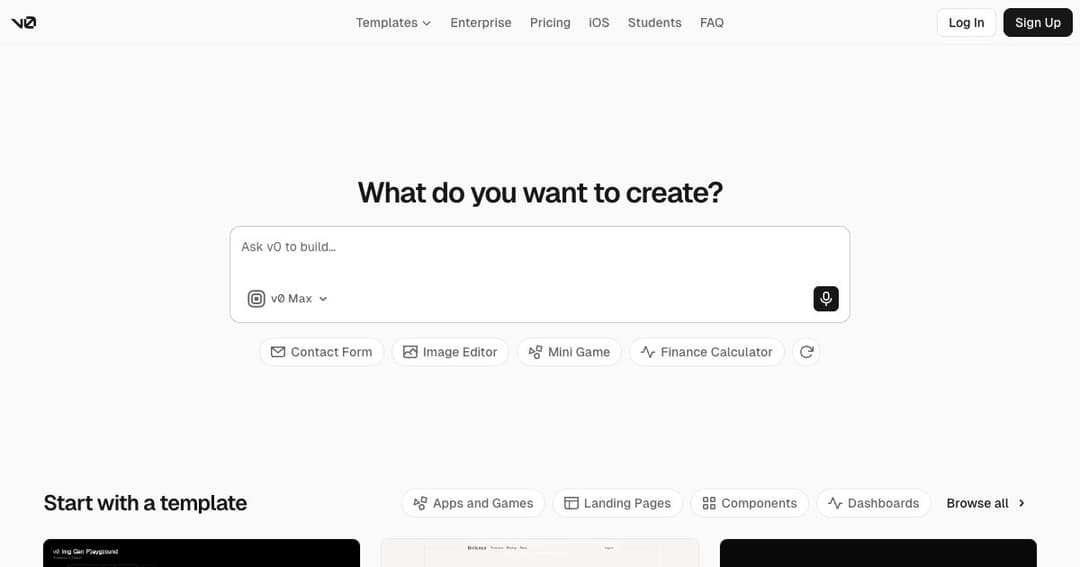
v0 is Vercel's AI builder. You describe an interface or an application, and it writes the React code — not a picture of a component, the component itself, in the same stack a Vercel-hosted product would use anyway. You can then edit it visually, push it to GitHub, and deploy it without leaving the page.
That last part is the difference between v0 and the general-purpose app builders it competes with. It is made by the company that runs the hosting, so the path from prompt to a live URL has no seams in it. The price of that smoothness is an opinion about your stack, which you are adopting whether or not you meant to.
It began as a component generator and grew into something that will build a full application with data and server logic. The component work is still where it is most reliably excellent.
Describe a pricing table, a navigation bar, a login form, a dashboard — you get working React with sensible structure and modern styling conventions rather than markup that only looks right in a screenshot. Iterate by describing the change, or fork the result and take it in a different direction.
Because the output is ordinary code in a conventional stack, a developer can read it, correct it and keep it. This is the practical dividing line between AI builders worth using and AI builders that generate something nobody can maintain.
Once something is generated, you can adjust it directly — spacing, text, colours — instead of writing another paragraph of prompt hoping the model understands «a bit tighter». For the last ten per cent of a layout, which is where prompting is worst, this is the feature that saves the most time and the most credits.
Projects sync to GitHub and deploy to Vercel, including on the free tier. The escape hatch is genuine: whatever you build here is a repository you can clone and continue in your own editor, which makes v0 usable as a starting point rather than a place you have to stay.
v0 offers its own model line-up rather than one setting: a small fast one for routine work, a balanced default, a maximum-capability tier for complex tasks, and the same maximum capability at higher speed. They differ by roughly fifty times in output cost between cheapest and dearest, so choosing deliberately matters more here than in most tools.
This is the part that surprises people. v0 does not bill by message or by project — the subscription buys a wallet of credits, and every message spends from it at the token rate of whichever model you chose.
| Model | Input per 1M tokens | Output per 1M tokens | Use it for |
|---|---|---|---|
| Mini | $0.20 | $1.20 | Routine changes, fast iteration, near-frontier quality |
| Pro | $2 | $10 | The sensible default for most work |
| Max | $5 | $25 | Complex tasks that the cheaper tiers get wrong |
| Max Fast | $10 | $50 | Same capability, 2.5× faster output, for rapid iteration |
Cached input is far cheaper than fresh input, which rewards staying in one conversation rather than starting over. And the reason short prompts consume large numbers of input tokens is that each message carries your project's context, not just the sentence you typed — a five-word instruction on a large project is not a five-word request.
Run out of included credits and you buy more on demand, shared across the team. The consequence worth planning for: two people on the same plan can spend wildly different amounts depending on which model they leave selected.
| Plan | Price | Included credits | What you get |
|---|---|---|---|
| Free | $0 | $5 a month | Deploy to Vercel, Design Mode, GitHub sync, capped at 7 messages a day |
| Plus | $30/user/mo | $30 a month per user, plus $2 daily on login | All models, team sharing, on-demand credits, central billing |
| Business | $100/user/mo | $30 a month per user, plus $2 daily on login | Everything in Plus, and training opt-out by default |
| Enterprise | Custom | Custom | Data never used for training, SAML SSO, role-based access, priority queues, support SLAs |
Look closely at Plus: thirty dollars a month buys thirty dollars of credits. You are not paying a margin on usage — you are paying for the account, the team features and a predictable ceiling, and the credits are effectively the whole fee. That is unusually honest pricing.
Business is the row to think hardest about. It costs more than three times Plus and includes the same thirty dollars of credits. The material difference is that your work is opted out of training by default. If that matters to your organisation it is worth the money; if it does not, you are paying seventy dollars a user for nothing you will notice.
The free tier is a real trial — five dollars of credits, deployment included — but seven messages a day is a hard stop rather than a soft one. It answers the question «is this any good» and cannot answer «can I finish this today».
The clearest case, and not the one people expect. v0 is at its best generating the components you would otherwise write from memory — forms, tables, modals, empty states — in code you can actually review. It removes typing, not judgement.
If your product already runs on this stack, v0 has no integration cost at all. The generated code belongs in your repository as it is, and the deployment is the one you already use.
A real, responsive, interactive page instead of a static frame — and Design Mode means you can adjust it yourself without asking anyone to rebuild it. For validating an interface with actual users, this is a different class of artefact.
Client pitch tomorrow, internal review this afternoon. Describe it, deploy it, send the link. The fact that the link is a real application rather than a mockup changes how the meeting goes.
There is a free plan with five dollars of monthly credits, Vercel deployment, Design Mode and GitHub sync, limited to seven messages a day. It is a genuine trial rather than a workable long-term plan.
Yes. Projects sync to GitHub, so the output is a repository you can clone and continue anywhere. That is the main reason to prefer it over builders whose output cannot leave the platform.
It depends on the model and on how much context your project carries. Output tokens range from about a dollar twenty per million on the small model to fifty on the fastest top-tier one, so the same request can differ in cost by more than an order of magnitude.
v0 is narrower and deeper: it is made by the hosting company, targets one stack, and is strongest at interface work. The general builders will do more kinds of application; v0 will produce React you are happier to keep.
On Business, training opt-out is the default. On Enterprise, data is never used for training. On the lower plans, check the current settings and terms rather than assuming.
Billing runs through vercel.com and deployment goes there by default, so in practice yes. You can still take the repository elsewhere and host it wherever you like.
v0 is the AI builder for people who were going to write React anyway. It generates interfaces good enough to keep, lets you fix the last ten per cent by hand instead of by prompt, and puts the result in GitHub where it belongs. Within its stack it is the strongest tool of its kind; outside it, most of the argument evaporates.
Watch the model selector more carefully than the plan selector — that is where the money goes. Start on Plus, keep the cheaper model for routine work, and only pay for Business if training opt-out is a requirement rather than a preference.