Udio
AI Music With Real Editing — and an Uncertain Future
Free
Describe a song and get a finished track with vocals, lyrics and instruments. Ten songs a day free — but the free tier does not give you commercial rights, and that is the part most people miss.
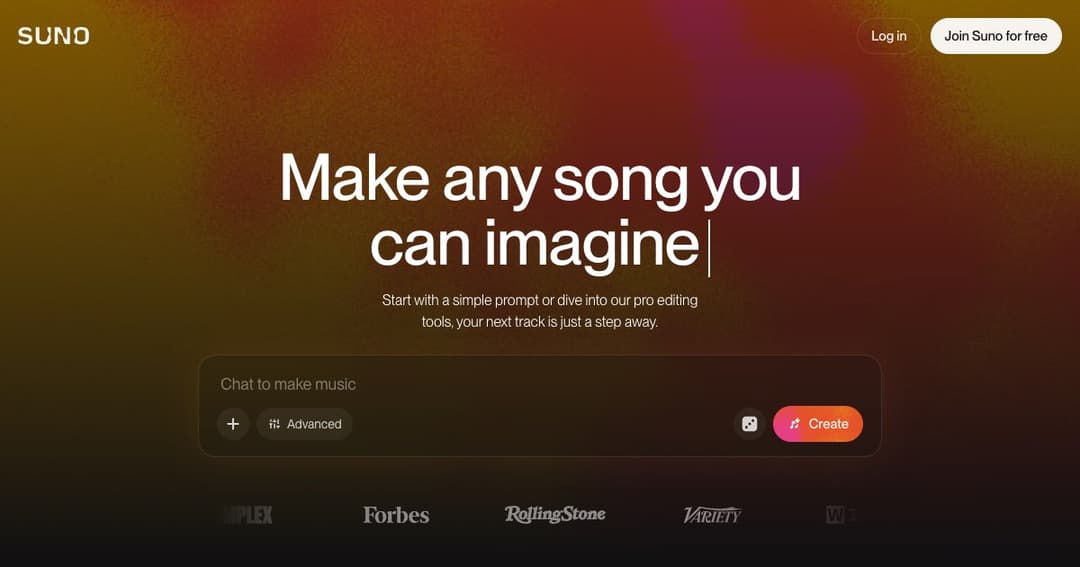
Suno turns a written description into a finished song — lyrics, vocals, instruments and arrangement, delivered as an audio file in about a minute. Not a backing track, not a loop pack: a track with a singer on it, verses, a chorus and an ending. That distinction is why it broke out of the AI-tools crowd and into ordinary conversation.
You can hand it a single line of mood and let it invent everything, or supply your own lyrics and a precise style prompt and keep control of the words. Both routes work. The second is where the tool stops being a novelty, because writing your own lyrics changes both the quality of the result and, as we will see, your legal position.
The free plan is not a teaser. Ten songs a day, every day, without a card. That is enough to decide whether this belongs in your work, which is more than most AI products offer.
Simple mode takes a description and handles the rest. Custom mode splits the job: you write the lyrics, you write the style, and you can mark structure with section tags so the model knows where a chorus begins. Style prompts respond to specificity — instrumentation, tempo, production era and vocal character land far better than genre labels alone.
Every generation costs credits, and credits are the real currency of the product. A song costs ten. The free plan replenishes fifty a day; the paid plans grant a monthly pool instead. Unused credits do not roll over from one period to the next — a detail worth knowing before you buy a large plan you will use in bursts.
The difference between a toy and a tool is what happens when the output is nearly right. Suno lets you extend a track, replace a specific section, crop and fade, and produce covers that keep a melody while changing the treatment. Personas capture the voice and feel of a track you like so later songs can inherit it — the closest thing here to a consistent artist identity.
Stem separation splits a finished song into parts, which is what makes Suno usable alongside a real DAW rather than instead of one. Paid plans also accept your own audio — up to thirty minutes on a subscription, eight on the free plan — so you can add vocals to an instrumental you already have, or hand it a hummed melody and ask for an arrangement around it.
The top tier includes Suno Studio, which is a workstation rather than a prompt box: MIDI, effects, automation and user-built plugins. It exists because the ceiling on prompt-driven music is low, and people who make a living from audio hit it in a week. If you already work in a DAW, this is the part that decides whether Suno stays in your workflow.
This is the single most misunderstood thing about Suno, and it is worth more than any feature comparison.
Songs made on the free plan belong to Suno. You may use them for non-commercial purposes only. Songs made while subscribed to a paid plan belong to you, with a licence to monetise them — and that applies to songs made while the subscription is active, so a back catalogue generated for free does not become commercial when you upgrade later.
Separately from ownership sits copyright, which is not the same thing. In the United States, copyright protects work created by a human, and a song generated entirely by AI from a prompt is unlikely to qualify — writing the prompt is not authorship. If you wrote the lyrics yourself, you own those lyrics and can usually register them, which is often the route to protecting the whole song. Some distributors decline material that is not copyrightable, so if the plan is to release commercially, sort this out before you record forty tracks.
There is a wider legal question too. The major labels sued Suno in 2024 over the music used to train it, and the industry has been moving toward licensing arrangements since. The ground under AI music is still shifting, and anyone building a business on it should treat today's terms as a snapshot rather than a settlement.
| Plan | Price | Credits | What you get |
|---|---|---|---|
| Free | $0 | 50 per day (10 songs) | Older model, shared queue, non-commercial use only |
| Pro | $10/mo, or $8/mo billed annually | 2,500 per month (~500 songs) | Commercial rights, latest model, priority queue, stems, 30-min uploads |
| Premier | $30/mo, or $24/mo billed annually | 10,000 per month (~2,000 songs) | Everything in Pro plus Suno Studio and advanced stem splitting |
Annual billing saves twenty per cent. Paid plans can buy add-on credits, and those top-ups do not expire — though they do require the subscription to stay active, so cancelling strands whatever you have left. Subscribers who burn through the monthly pool drop back to fifty credits a day rather than stopping entirely.
One change deserves attention: from early September 2026 the paid plans cap song downloads at twenty a month on Pro and sixty on Premier. Generation limits are unchanged, but if your use of Suno depends on exporting large numbers of finished files, that ceiling now sits well below the credit allowance and should shape which plan you pick.
The clearest case. Intros, beds, stings and transitions that fit the exact length and mood you need, cleared for commercial use on a paid plan, at less than the price of a single stock-music licence. For this audience Suno is not competing with musicians — it is competing with a library subscription, and it wins on fit.
Hearing a lyric sung, in three arrangements, in the time it takes to make coffee, is a genuinely different way to write. Whether the output ships matters less than whether the sketch tells you the second verse is weak. Custom mode plus your own lyrics is the configuration that makes this work.
Jingles, ad soundtracks and campaign-specific music that would otherwise mean briefing a composer. The economics are hard to argue with, and the commercial licence on a paid plan is what makes it usable at all.
Birthday songs, in-jokes, a track for someone who will never hear their name in a chorus otherwise. Ten a day for nothing. This is the use that made Suno famous, and it needs no defending.
Yes, permanently: fifty credits a day, roughly ten songs, with no card required. The free tier uses an older model, puts you in a shared queue and grants non-commercial use only.
Only songs created while you hold a Pro or Premier subscription. Those you own, with a commercial licence. Anything made on the free plan stays non-commercial and remains Suno's property.
Ownership and copyright are different questions. A paid plan gives you ownership of the track, but a song written entirely by AI probably is not eligible for copyright protection in the US. Write the lyrics yourself and you own those, which is usually the strongest basis for registering the song.
About 500 on Pro and 2,000 on Premier, since a song costs ten credits. Run out and you drop to fifty credits a day rather than nothing. Note that downloads are capped separately from September 2026.
Both. Custom mode takes your lyrics and structure tags. Paid plans accept audio uploads of up to thirty minutes, so you can extend a recording, add vocals to an instrumental, or build an arrangement around a melody you hum.
They are the two serious players in full-song generation and both faced the same label litigation. Suno is further along on editing, stems and the Studio workstation; preferences on vocal quality vary by genre and by listener. The free tiers make a direct comparison cheap — spend an evening on both with the same lyrics.
Suno is the most convincing demonstration that generative audio has arrived. For anyone who needs music rather than makes it — video, podcasts, advertising, games — it replaces a stock library at a fraction of the cost and fits the brief far better. Ten free songs a day means the evaluation costs nothing but an evening.
Go in knowing two things. The free tier does not give you commercial rights, and no plan gives you copyright over a song you did not write. Bring your own lyrics, keep a subscription active while you make anything you intend to release, and treat the current terms as a moving target rather than a guarantee.