Roketfy
AI-Powered Tools to Skyrocket Your Etsy Sales
Free
Seven research tools for Etsy sellers — keyword finder, shop analyzer, hidden listing stats and tag extraction. Free tier, paid from $4.99/month.
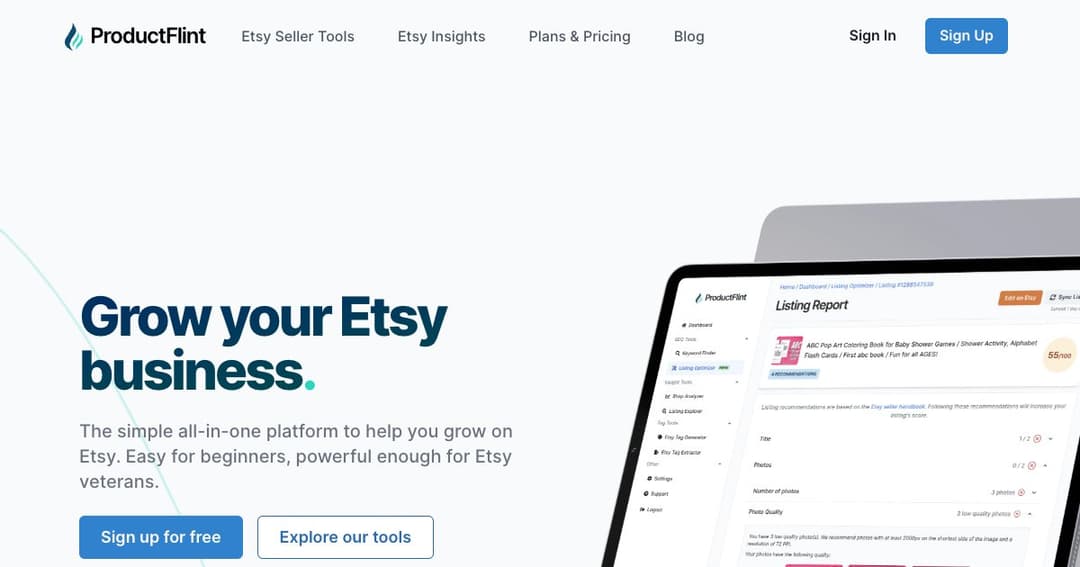
ProductFlint is a set of research tools for Etsy sellers. It answers the questions that decide whether a listing sells: what shoppers actually type into Etsy search, which tags competitors are using, and how much a rival shop is really making. It reads Etsy's own data through the official API and puts it in front of you in a way Etsy itself does not.
This matters because Etsy tells sellers remarkably little. You can see your own stats and nothing else — no search volume, no competitor revenue, no way to know whether a keyword is worth targeting before you commit a listing to it. Tools like this exist to close that gap.
This is the thing worth knowing before anything else, and no other write-up mentions it.
ProductFlint is live and working at productflint.com, with its own pricing and tools. But a second product called ListingView occupies the same niche, is marked BETA, carries a 2026 copyright, and is far larger in scope — asset library, mockup generator, bulk listing editor, print-on-demand fulfilment, multi-channel sync to TikTok Shop and Shopify. Several third-party reviews describe ListingView as ProductFlint renamed.
We could not confirm that. Neither site mentions the other: ProductFlint's pages carry a 2023 copyright and say nothing about a successor, and ListingView's homepage and footer never mention ProductFlint. The two share an identical Etsy trademark disclaimer, which is suggestive and nothing more.
What that means practically: ProductFlint still works and still charges, but its site has shown no visible movement for a long time. Treat it as a cheap, functional research toolkit rather than a product under active development, and check the branding on the page you are actually entering card details into.
The centrepiece. Shows what shoppers are searching for so a title and description can be built around real demand instead of what you would call the product yourself. Most Etsy listings fail here — sellers describe their item in their own words rather than the buyer's.
Tracks a competitor's sales and shows which of their products actually move. Useful less for copying than for calibration: a niche where the top shop makes a handful of sales a month is a different proposition from one where it makes hundreds.
Reveals per-listing statistics that Etsy does not display publicly — total sales, favourites and revenue for an individual item. This is the closest thing to seeing a competitor's books.
The generator proposes relevant tags from a starting word; the extractor pulls the tags off a competitor's listing in one click. Etsy allows thirteen tags per listing and most sellers waste several of them, so this is the fastest available improvement to an existing shop.
Two browsing tools rather than research ones: statistics on the largest Etsy shops, and keyword trends across the marketplace. Good for spotting a rising search term before the category fills up.
Three tiers, and the difference between them is search volume rather than features. Annual billing takes roughly 40% off.
| Free | Spark — $4.99/mo | Blaze — $9.99/mo | |
|---|---|---|---|
| Keyword Finder | 15 searches/mo | 100 searches/mo | Unlimited |
| Listing Optimizer | 10 listings | 100 listings | 325 listings |
| Shop Analyzer | 10 searches/mo | 75 searches/mo | Unlimited |
| Listing Explorer | 10 searches/mo | 75 searches/mo | Unlimited |
| Annual saving | — | $30/year | $60/year |
The free tier's fifteen keyword searches a month sound generous until you use them. Proper research on one product means checking a dozen phrasings, so fifteen searches is roughly one listing researched properly — enough to see whether the data is useful to you, not enough to run a shop.
For most sellers Spark is the sensible choice, and the arithmetic is not close: $4.99 a month against a single Etsy sale is trivial, and the category leaders in Etsy analytics charge several times more. Blaze earns its money only if you are researching constantly or managing a catalogue in the hundreds.
Mostly no, and it is better for the honesty. This is marketplace data analysis: Etsy's API supplies the numbers, ProductFlint aggregates and presents them. The tag generator is the only piece doing anything resembling suggestion, and even there the value comes from real Etsy search data rather than generated text.
That is the right design for the job. A seller choosing keywords needs to know what people actually searched for, not what a language model thinks sounds plausible — and generated tags that nobody types are worse than useless, because they occupy one of your thirteen slots.
The clearest fit. Before your first listing goes up, knowing whether a niche has demand and what shoppers call the thing you are selling changes everything downstream. At $4.99 the barrier is low enough not to think about.
The common diagnosis for a quiet shop is that listings are invisible rather than unattractive — wrong words in the title, half the tag slots wasted. The tag extractor against three successful competitors is often an afternoon's work with a visible result.
When product creation is cheap, picking the right design and keywords is the entire game. Research tooling matters more here than anywhere else on Etsy.
There is a free plan with 15 keyword searches and 10 searches each on the shop and listing tools per month. Paid plans are $4.99 and $9.99 a month, about 40% less on annual billing.
Third-party reviews say ListingView is ProductFlint renamed, but neither company's site confirms it. Both are live, both serve Etsy sellers, and ListingView is much broader and marked BETA. Check which brand you are signing up to.
It shows estimates built from publicly available Etsy data — sales counts, favourites and prices. Useful for comparing one shop against another; not a substitute for actual figures.
It runs on Etsy's official API. The site notes it is not endorsed or certified by Etsy, which is standard for every tool in this category.
No. It supplies keywords, tags and competitor data. Writing the title and description remains yours — which is the part where knowing the right words is worth the most.
ProductFlint does the unglamorous half of Etsy selling — finding out what people search for and what competitors are doing — and charges very little for it. For a new seller it is among the cheapest ways to stop guessing, and the tag tools alone can justify a month's subscription on an existing shop.
The caution is about the product rather than the tools. A 2023 copyright on a live site, no visible development, and an unexplained overlap with a newer platform in the same niche all point the same way. Use it for what it does today, pay monthly rather than annually until the picture is clearer, and do not build a workflow that would break if it quietly stopped.