Charley
Essay Writing Assistant for Students
Free
Google's research assistant that answers only from documents you upload, with a citation behind every sentence — and turns them into podcast-style audio. Renamed from NotebookLM in July 2026. Free tier is genuinely usable.
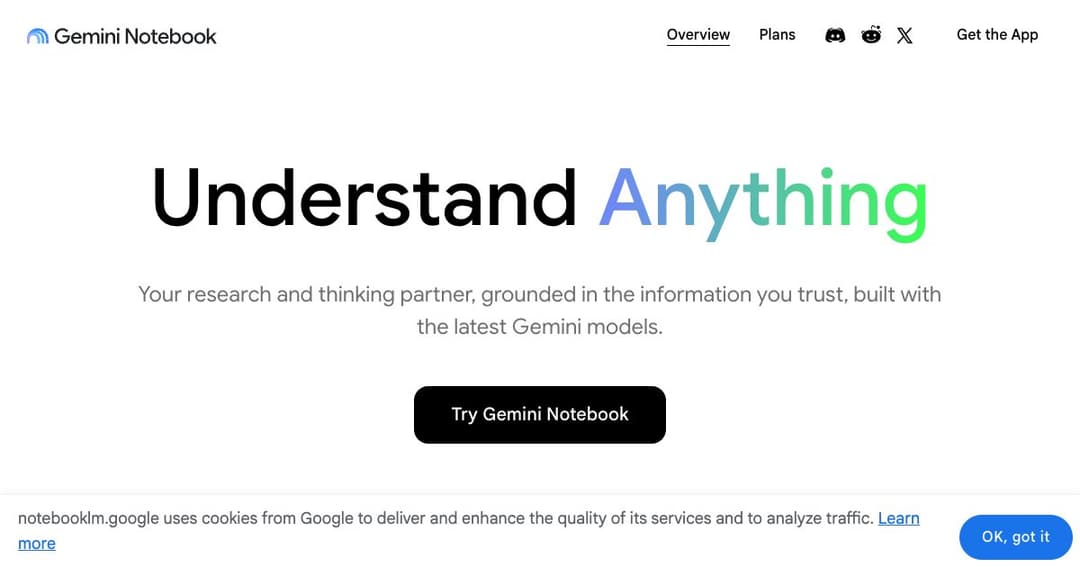
NotebookLM became Gemini Notebook in July 2026. Same product, same notebooks, nothing lost — Google folded the name into its wider AI line-up. If you arrived here searching for NotebookLM, you are in the right place, and your existing notebooks are still where you left them.
The rename signals the direction: what began as a standalone experiment is being pulled into Google's broader assistant, while remaining usable on its own across web and mobile.
Most AI assistants answer from everything they have ever read. This one answers only from what you give it. You upload documents — PDFs, web pages, YouTube videos, audio recordings, Google Docs and Slides — and every response is drawn from that set and nothing else.
That constraint is the entire product, and it is why researchers, students and lawyers took to it faster than to general chatbots. When the model cannot reach past your sources, the failure mode changes: instead of confident invention, you get «that is not in your material.» Every claim carries a citation pointing at the exact passage it came from, so verification takes a click rather than an afternoon.
It is not a search engine and not a writing assistant. It is a way of interrogating a body of material you already trust.
The feature that made the product famous. One click turns your documents into a conversation between two synthetic hosts discussing the material — genuinely listenable, with pacing and interruptions that sound like a real podcast. For anyone who absorbs things better by ear, or who commutes, it converts a folder of PDFs into something you can actually get through.
The novelty wears off; the usefulness does not. It is particularly good at giving you a working understanding of unfamiliar material before you sit down to read it properly.
Video overviews for visual explanation, flashcards for revision, structured reports, presentation outlines with supporting evidence, and infographics for material you intend to publish. All of them stay tied to your sources, which is what separates them from asking a general model to invent a study guide.
Source discovery and a deep research mode let you pull new material into a notebook from inside it, rather than gathering everything by hand first. For a literature review this is the difference between a tool that helps at the end and one that helps from the beginning.
The free tier is real and generous: standard generation limits, access to Google's models, and up to fifty sources in a notebook. For most students and most one-off research projects that is the whole product, at no cost.
The paid tiers are not sold separately — they come bundled with Google's AI subscriptions, which raise both the generation limits and how many sources a notebook holds.
| Tier | Generation limits | Sources per notebook | Model access |
|---|---|---|---|
| Free | Standard | Up to 50 | Standard |
| With AI Plus | 2× standard | Up to 100 | Early access to new features |
| With AI Pro | 5× standard | Up to 300 | Higher access, priority |
| With AI Ultra | Up to 50× standard | Up to 600 | Highest access, priority |
| Business / Education | By plan | By plan | Through Google Workspace |
| Enterprise | By plan | By plan | Through Google Cloud |
Subscription prices are set per region and differ substantially between countries — in the euro zone the entry AI plan runs around five euros a month, the main tier around twenty-two, and the top tier from a hundred. Check the price in your own country rather than converting; the paid plans are also unavailable in some regions entirely.
The practical advice: do not subscribe for this alone. If you already pay for Google's AI subscription, the higher limits are included. If you do not, work out whether the free tier's ceilings actually constrain you before adding a monthly bill.
The clearest case, and the one the product is visibly designed around. Lecture recordings, textbook chapters and papers go in; explanations, flashcards and audio recaps come out, all traceable back to the source. A literature review across dozens of papers stops being a reading marathon and becomes a conversation.
Contracts, reports, meeting transcripts, regulatory filings. The value is not summarisation — it is being able to ask a specific question across two hundred pages and get an answer with the paragraph attached.
Onboarding manuals turned into video walkthroughs, help-centre articles turned into a notebook that answers customer questions from your own documentation. Consumer accounts can publish a notebook publicly, which is an unusually cheap way to make a knowledge base answerable.
Audio Overviews alone justify the free tier for a large number of people. Turning material you must know into something you can hear on a walk is a genuine change in how a week is organised.
Google states that data from organisations and schools stays private to them and is not used to train the models. For individual accounts, your data is likewise not used for training unless you submit feedback. Given that people upload unpublished research and confidential documents here, this is worth reading in the current terms rather than taking from any summary — including this one.
Yes. NotebookLM was renamed Gemini Notebook in July 2026. It is the same product, and existing notebooks remain fully accessible.
Yes, with a usable free tier: standard generation limits and up to fifty sources per notebook. Higher limits come with Google's paid AI subscriptions rather than as a separate purchase.
PDFs, websites, YouTube videos, audio files, Google Docs and Slides, among others. The mix matters less than the total — a notebook holds up to fifty sources on the free tier and more on paid ones.
It is designed not to: answers come from your uploaded sources and carry citations to the passage they came from. That removes a large class of errors, but it does not verify that your sources are accurate — check the citation, not just the answer.
A generated discussion between two synthetic hosts working through your material, produced in one click. It is the feature most people know the product for, and it is available on the free tier.
Yes — through Google Workspace for business and education, and through Google Cloud for enterprise, with organisational data kept private. Note that publishing a notebook publicly is a consumer-account feature only.
Gemini Notebook is the most convincing answer yet to the complaint that AI assistants sound authoritative about things they have not read. By restricting the model to material you chose and citing every sentence back to it, Google built the rare AI product that a researcher can defend using.
Start on the free tier, which is enough for most work, and upgrade only if you already pay for Google's AI subscription or you genuinely run into the source limit. Whatever you do, treat the citations as the feature — the moment you stop clicking through to check them, you have given up the thing that made this different.