Amplemarket
AI Sales Copilot for Revenue Teams
A CRM for small sales teams with calling, email and SMS built in, plus an AI assistant called Chloe on every plan. From $9 per user billed annually.
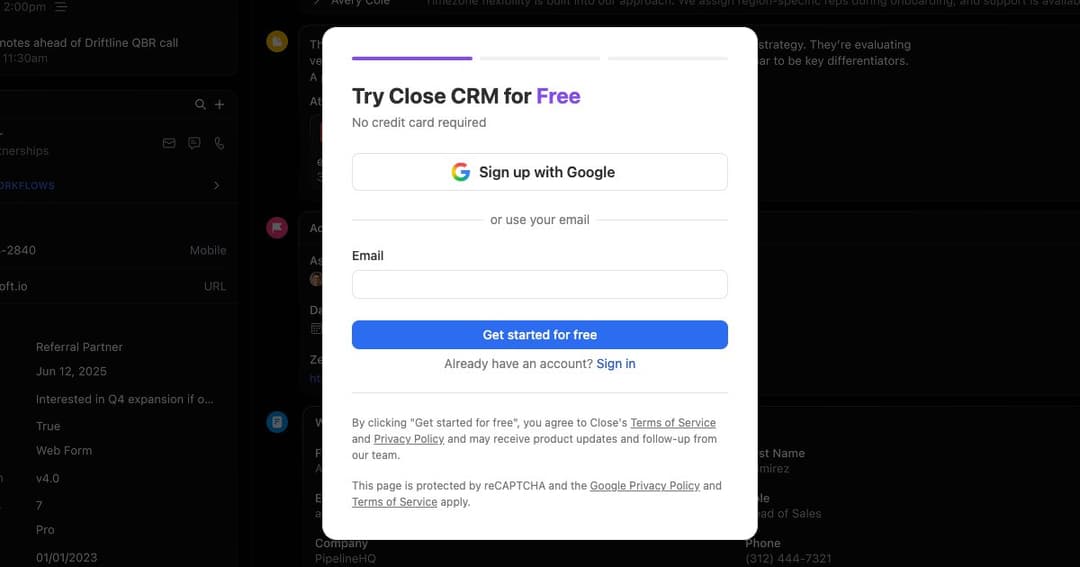
Close is a CRM built on a specific opinion: that a salesperson should not have to leave the CRM to actually sell. Calling, email and SMS are part of the product rather than integrations bolted on, so the record of a conversation and the means of having it live in the same window.
That sounds minor until you have watched a rep alternate between a dialler, an inbox and a database, updating the last one from memory at the end of the day. Close removes the copying step, and most of what people like about it traces back to that single decision.
The AI layer is an assistant called Chloe, and it is on every plan including the cheapest — which is not how most CRMs price AI. Enterprise tools tend to reserve it for the tier above whichever one you are on.
Calls are placed from inside Close and logged automatically. Emails send and thread there. SMS too. Nothing has to be reconstructed afterwards, which matters because reconstructed CRM data is usually wrong data — nobody remembers the objection accurately three hours later.
For outbound teams this is the whole argument. The gap between a CRM that records what happened and one that is where it happened shows up in how much of the pipeline is actually trustworthy.
Chloe handles the AI work — including batch calling, chat in beta, and enrichment that fills in what you do not know about a lead. Every tier gets her, with a monthly credit allowance that refreshes and does not roll over: 500 on Solo, 1,000 on Essentials, 1,500 on Growth, 2,000 on Scale.
The no-rollover rule is worth noting. Unused credits vanish at the end of the month, so the allowance rewards steady use rather than occasional bursts, and a team that works in campaigns will find the ceiling in a bad week and waste credits in a quiet one.
Growth and Scale add the ability to use Chloe inside workflows rather than only on demand, plus automatic updates to playbooks and custom fields. That is the difference between an assistant you ask and an assistant that runs on its own.
Scale alone adds the ability to restrict who can use Chloe. Sounds like an administrative footnote; it is the feature a compliance team will insist on before anyone in a regulated business is allowed to point AI at customer records.
Pricing is per user per month. Solo is capped at one person; everything above it is unlimited seats at the per-user rate.
| Plan | Annual | Monthly | AI credits | Users |
|---|---|---|---|---|
| Solo | $9 | $19 | 500/month | 1 only |
| Essentials | $35 | $49 | 1,000/month | Unlimited |
| Growth | $99 | $109 | 1,500/month | Unlimited |
| Scale | $139 | $149 | 2,000/month | Unlimited |
Here is the thing the price table does not say out loud: the annual discount collapses as you climb. Solo saves 53% by paying yearly, Essentials 29%, Growth 9% and Scale 7%. The commitment is worth a great deal at the bottom of the ladder and almost nothing at the top.
The practical consequence is that a solo operator should pay annually without hesitating, while a team on Scale can stay monthly and keep the flexibility for the price of a rounding error. That is the opposite of the usual advice, and it follows directly from their own numbers.
There is a free trial with no card required and a 30-day money-back guarantee behind it.
The built-in dialler with automatic logging is the core case. If your reps make thirty calls a day, the minutes saved on data entry are the whole return, and Chloe's batch calling extends that further.
Solo at $9 a month annually is priced below the point where anyone needs to justify it. For a founder doing their own sales, it is a cheaper way to stop losing follow-ups than any process change.
Close exists because Salesforce implementations take a quarter and a consultant. If your objection to enterprise CRM is the setup rather than the price, this is the category it was built for.
Because the calls happen inside the tool, the reporting reflects what actually occurred rather than what someone typed. Coaching from real conversation data is a different exercise from coaching off a pipeline someone updated on Friday afternoon.
No permanent free plan, but there is a free trial with no card required and a 30-day money-back guarantee afterwards. The cheapest paid tier is $9 per user a month billed annually.
Close's AI assistant, included on every plan. She handles batch calling, chat in beta and lead enrichment, and from the Growth tier upward she can run inside workflows rather than only when asked.
No, and that is the point of the product. Calling, email and SMS are built in, with activity logged automatically rather than entered by hand afterwards.
Depends entirely on your tier, and the answer is unusual. On Solo, annual saves 53% and is an obvious yes. On Scale it saves 7%, which is rarely worth locking in a year for.
They expire. Credits refresh monthly and do not roll over, so the allowance suits consistent use rather than intense bursts followed by quiet periods.
Only on Scale, which is the sole tier offering restrictions on Chloe access. For regulated businesses that single line often decides which plan is even permissible.
Close is a CRM for people who sell by talking to humans, and its best idea is old-fashioned: put the phone inside the database so nobody has to remember what was said. Including the AI assistant on every tier rather than gating it behind an upgrade is a genuinely unusual bit of pricing honesty.
Read the annual column carefully before committing. The discount is enormous at the bottom and negligible at the top, which means the sensible billing choice is different for a founder than for a sales team — and nobody tells you that on the pricing page.