Hypotenuse AI
Content Platform for Ecommerce
Free
Source from AliExpress, Alibaba and Temu into Shopify, with AI-written product descriptions and a generated storefront. Trial is $1 for 7 days, plans from $39.
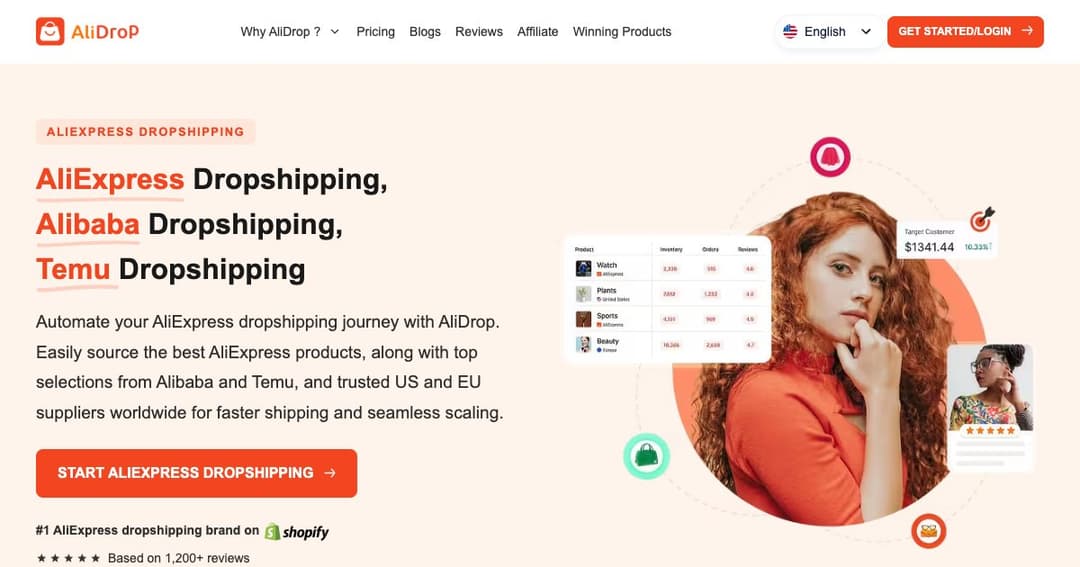
AliDrop connects a Shopify store to AliExpress, Alibaba and Temu, then automates the tedious half of dropshipping: importing products, keeping stock in sync, and pushing orders through to the supplier when a customer buys. It positions itself as the leading AliExpress dropshipping app on Shopify, with more than 1,200 reviews behind that claim.
It is worth being precise about where the AI actually sits, because the marketing is broader than the reality. Two features use it: a generator that writes product titles and descriptions, and a store builder that spins up a Shopify storefront pre-populated with trending products. Everything else — the importing, the syncing, the fulfilment, the supplier catalogue — is conventional automation that works the same way it did before any of this was called AI.
That is not a criticism, and for this job it may be the right split. Dropshipping fails on logistics and product selection far more often than it fails on copywriting. But if you are here expecting an AI product that happens to do dropshipping, you will find a dropshipping product that has added AI where AI genuinely helps.
The name says AliExpress, but the platform also pulls from Alibaba and Temu, and runs its own marketplace of US and EU suppliers. That last part is the one that matters commercially: shipping from China is where most dropshipping stores lose customers, and a domestic supplier turns a three-week wait into a few days.
Products import into Shopify in one click, and inventory stays synced afterwards so you are not selling something the supplier has run out of. Orders route to the supplier automatically when a customer checks out.
There is a winning products feed, a product analyzer, trend monitoring and competitor analysis. This is the part of dropshipping that actually decides whether a store makes money — sourcing and fulfilment are solved problems, but picking the wrong product means excellent logistics delivering something nobody wants.
Treat any winning products list with the scepticism it deserves, on this platform or any other. A product visible to every subscriber is by definition a product your competitors can also see, and the ones featured longest are usually the ones already saturated.
The description generator writes titles and product copy, which saves real time when you are listing hundreds of items — supplier-provided descriptions are usually machine-translated and unusable as they stand. This is a genuine fit: high volume, low creative stakes, and anything is better than the original.
The AI store builder generates a whole Shopify storefront with trending products already in it. Useful for getting from nothing to something in an afternoon, and worth remembering that a generated store looks like every other generated store — differentiation has to come from you afterwards.
All four tiers carry identical features. The only thing that changes is how many products you can hold, which makes the pricing unusually easy to reason about.
| Plan | Monthly | Annual | Unique products | Premium products |
|---|---|---|---|---|
| Starter | $39/mo | — | 50 | 25 |
| Professional | $59/mo | $24/mo | 500 | 250 |
| Empire | $99/mo | $57/mo | 5,000 | 2,500 |
| Unicorn | $299/mo | $79/mo | 25,000 | 25,000 |
The trial is $1 for seven days, not free — the homepage says free trial and the pricing page says a dollar, and the pricing page is the one that charges you. It is a trivial amount, but it means a card up front.
Now the part worth actually acting on. The annual discounts are wildly uneven: Professional saves 59%, Empire 42%, and Unicorn 74%. Paid annually, Unicorn costs $79 a month against Empire's $57 — 39% more money for five times the products. If you are committing to a year at all, the top tier is the obvious pick, and the monthly price list actively misleads you about that, because monthly Unicorn is three times Empire.
The generated storefront and the winning products feed remove the two things that stall beginners: an empty store and no idea what to sell. Starter at 50 products is sized precisely for finding out whether you enjoy this before spending more.
The US and EU supplier marketplace is the strongest reason to choose this over a pure AliExpress connector. Delivery time is the complaint that generates refunds and kills repeat purchases, and domestic sourcing is the only real fix.
Where the AI description generator earns its place. Rewriting 500 machine-translated supplier listings by hand is a week of work nobody wants; doing it in bulk is the difference between a catalogue that reads like a shop and one that reads like a scrape.
High product ceilings on the upper tiers suit people running several stores or rotating catalogues fast. If your method is to launch, measure and cull, the Unicorn annual price makes that affordable in a way the monthly one does not.
Not quite. The trial is seven days for $1, on every tier, and requires a payment method. After that the plan you chose bills at its normal rate.
No. The integration is built around Shopify, and the store builder generates a Shopify storefront. Other platforms are not supported.
AliExpress, Alibaba and Temu, plus AliDrop's own marketplace of US and EU suppliers. The domestic suppliers cost more per unit and ship in days rather than weeks, which usually pays for itself in refunds you do not issue.
Starter if you are finding out whether dropshipping suits you — 50 products is enough to test a niche. If you already know you are committing for a year, go straight to Unicorn on annual billing: at $79 a month it is barely above Empire and gives you five times the catalogue.
Good enough to beat what the supplier gave you, which is a low bar and the relevant one. For a handful of hero products, write the copy yourself. For the long tail of a 500-item catalogue, generated descriptions are the right call.
Yes. Orders route to the supplier when a customer buys, and inventory syncs back to Shopify so you are not selling stock that no longer exists. That automation is the core of the product.
AliDrop is a competent dropshipping platform whose best feature is not artificial intelligence at all — it is the marketplace of US and EU suppliers, because shipping time is what makes or breaks these stores. The AI description writer is genuinely useful at volume, and the store generator is a reasonable way to skip a blank page.
Judge it as dropshipping software rather than as an AI tool, and read the pricing on the annual column. The gap between what the monthly and annual tables suggest is the single most expensive misreading available here.