AllSearch
Book Search AI-Powered Tool for Education Research
Talk to Books was Google’s AI experiment that let users discover ideas by exploring books through natural language. Though now closed, it showcased the power of semantic search in literature.
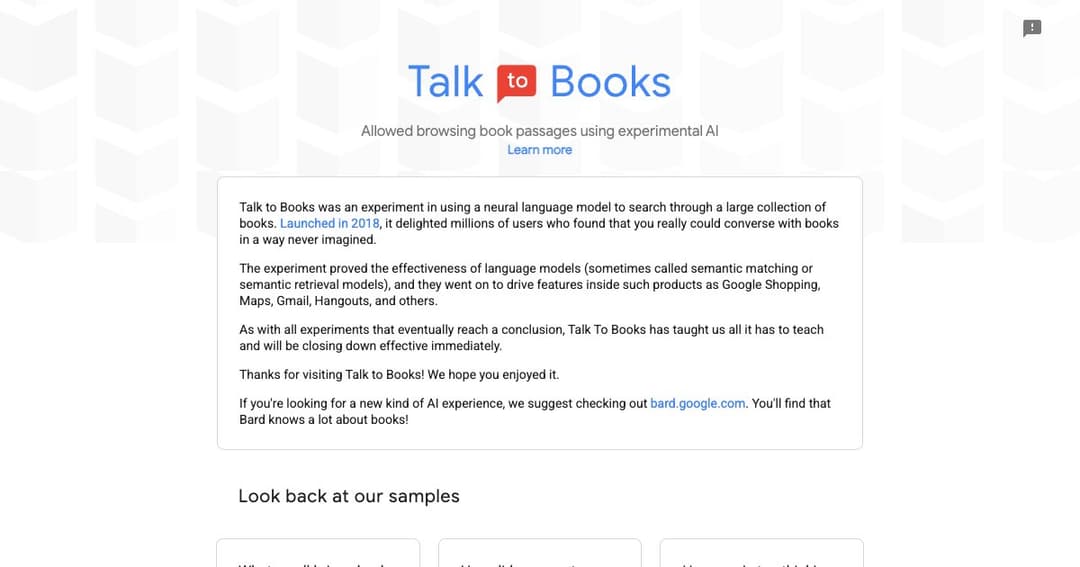
Talk to Books was an innovative tool created by Google in 2018 that allowed users to explore ideas and answers by conversing with a vast collection of books. Unlike traditional keyword search, it used semantic matching—an early application of language models—to deliver relevant excerpts based on the meaning of your query.
By asking questions or typing statements, users received real-time book passages that matched the intent of their input. The tool demonstrated how AI could surface deep insights from literature in ways traditional search engines could not.
Instead of relying on keyword matches, Talk to Books interpreted natural language to retrieve semantically related text. This approach made it possible to answer open-ended or complex queries with nuanced results pulled directly from books.
The experiment drew from a vast library of digitized books, using machine learning to understand context and relevance. It essentially created a bridge between readers and the knowledge hidden in books.
Users often asked questions like «Why is a free press important?» or «How do I find my own guitar sound?» The responses offered a unique way to reflect on big questions through the lens of published authors.
From science and technology to relationships and history, Talk to Books surfaced excerpts that helped users engage with complex topics without needing to know exact search terms.
The AI behind Talk to Books informed features across various Google services, including Gmail, Google Shopping, and Maps. It proved that neural language models could enhance product search, smart replies, and more.
Although the service has been discontinued, its contributions to AI development continue to live on. For those seeking similar AI experiences, Google now recommends exploring Google Bard, which offers expanded capabilities including book-related insights.