Mark Copy
AI Content Creation Aligned with Your Brand Voice
Free
Jasper builds AI into marketing workflows — brand voice governance, bulk content execution and GEO for AI search visibility. Real pricing, and when a cheaper assistant wins.
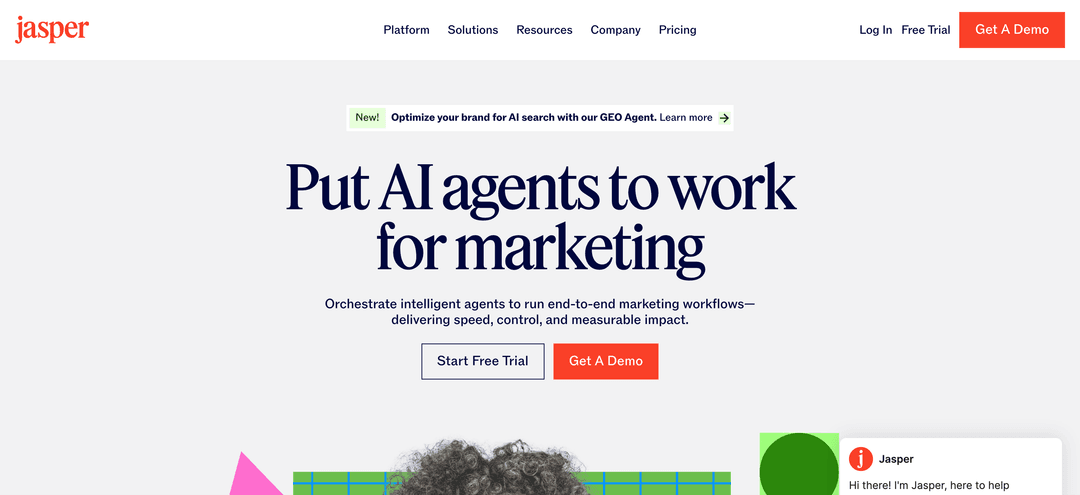
Jasper is an AI platform built for marketing teams rather than for general use. It started as an AI copywriter in the era when generating decent marketing text was genuinely hard, and it has spent the years since moving away from that — because writing stopped being the hard part.
What it sells now is governance and repeatability: keeping output consistent with a defined brand voice, running the same workflow across hundreds of items, and getting a brand cited by AI search engines. If you are evaluating Jasper against a general assistant, that shift is the entire argument, and it is worth understanding before looking at the price.
This matters because the obvious objection is fair: ChatGPT and Claude write well and cost around $20 a month. Jasper starts at nearly three times that. The response is not that Jasper writes better — it is that Jasper is a system rather than a chat window.
A general assistant produces a good draft when a person prompts it well. Jasper is built for the case where twelve people need on-brand output without each of them being a good prompter, where the same task runs across two hundred product pages, and where someone has to answer for consistency. Whether that is worth paying for depends entirely on whether you have that problem.
The content workspace — an editor and chat where drafting actually happens, with brand context already applied rather than pasted into every prompt.
The brand intelligence layer, and the piece that makes the rest coherent. You define brand voice, target audiences, visual standards, knowledge assets and style guides once, and every agent, document and bulk job is grounded in them. This is the difference between a tool that writes and a tool that writes like your company.
Purpose-built agents handle marketing workflows end to end rather than answering single requests — research, localisation, optimisation. On the Business plan there is also a no-code builder for creating custom agents, which is how teams encode their own recurring processes.
Bulk execution in rows and columns: run an agent-powered workflow across a large set of items at once — localising a catalogue, rewriting descriptions, optimising a batch of pages. Grid is where the platform earns its keep at scale, and it is the thing a chat interface fundamentally cannot do.
Jasper does not tie itself to one model family; it selects models per task across providers. Practically this means you are buying the workflow layer rather than betting on whichever lab is ahead this quarter — a reasonable hedge, given how quickly that changes.
Jasper's clearest 2026 bet is Generative Engine Optimization — optimising content so that assistants like ChatGPT and Gemini cite it as a source. As people increasingly ask an assistant instead of scrolling a results page, being the answer matters more than ranking near it.
The GEO Agent, launched in June 2026 alongside GEO Hub, continuously analyses how a brand appears across AI search, identifies visibility gaps and runs optimisation workflows against them, tracking citations, sentiment and share of voice. Whether GEO becomes a durable discipline or a rebranding of good content practice is genuinely unsettled — but Jasper is further into it than most marketing platforms, and if your traffic is already shifting from search results to assistant answers, it is aimed squarely at that.
The core case. Several people producing content that must sound like one company, with brand rules enforced by the tool instead of by review cycles.
Separate brand voices and knowledge bases per client, and bulk execution when the same deliverable is needed across an account list.
Grid is built for exactly this: hundreds of product descriptions localised or rewritten in one pass, rather than one prompt at a time.
Governance, admin controls, API access and deployment options — the requirements that usually decide these purchases regardless of output quality.
Solo creators and small teams are the group most likely to overpay here. If one person writes everything and brand consistency is not a coordination problem, a general assistant covers the same ground for far less.
Jasper is priced as a marketing platform, not a writing app, and the structure changed: the old Creator tier is gone, so Pro is now the entry point.
| Plan | Monthly | Annual (per seat) | Seats | What You Get |
|---|---|---|---|---|
| Pro | $69 | $59 | 1 | Canvas, agents, 2 brand voices, image generation |
| Business | Custom | Custom | Multiple | Advanced agents, Grid, API, governance, unlimited brand assets |
This is the detail that surprises people. Pro includes one seat, and adding team members means moving to Business rather than paying for another seat. So the moment Jasper becomes a team tool, you leave public pricing behind and enter a sales conversation — and since the platform's whole argument is about team consistency, most serious buyers end up there.
Only a 7-day trial on Pro. Given that the value shows up in brand setup and repeated workflows rather than in a first draft, a week is a tight window to evaluate what you are actually buying. It is worth arriving with brand assets ready rather than starting from scratch on day one.
Business is quoted per organisation based on seats, usage, API needs and support level. Published figures from third parties vary widely and depend heavily on team size, so treat any specific number you read — including in reviews — as an estimate rather than a rate card.
The honest comparison is not about writing quality. Modern general models write marketing copy well, and for a single person with a clear brief they are often faster because there is nothing to configure.
Jasper wins on three things: brand consistency enforced across people rather than remembered by them, bulk execution across large sets, and governance features that procurement teams require. It loses on price, on setup effort, and on flexibility outside marketing. If you cannot name which of those three wins applies to you, the cheaper tool is the right answer.
No. Jasper offers a 7-day free trial on the Pro plan, but there is no permanent free tier.
Pro is $69 per seat per month, or $59 per seat billed annually. Business is custom-priced based on seats, usage and support needs. The former Creator plan is no longer offered.
Not on Pro, which includes a single seat. Team usage requires the Business plan, which also adds Grid, API access, the custom agent builder and admin governance.
Not inherently. General models write marketing copy to a similar standard. Jasper's advantage is brand governance across multiple people, bulk workflows and enterprise controls — not raw text quality.
Generative Engine Optimization: optimising content so AI assistants cite your brand as a source. Jasper's GEO Agent and GEO Hub track brand visibility, citations and sentiment across AI search and run optimisation workflows against the gaps.
Jasper is model-agnostic and selects across providers depending on the task, rather than committing to a single model family.
That is the main thing you are paying for. Jasper IQ stores brand voice, audiences, knowledge and style guidance, and applies them across agents, documents and bulk jobs so consistency does not depend on individual prompting.
Jasper is no longer competing on whether AI can write a decent paragraph — that argument ended, and everyone won it. It competes on making a marketing team's output consistent, repeatable at scale, and visible in AI search, which are real problems that a chat window does not solve.
The price makes the decision sharp. At $59 to $69 per seat with no free tier and team usage behind a sales call, Jasper is worth it when brand consistency across several people is an actual operational problem, or when you are running workflows across hundreds of items. For a solo marketer or a small team with one writer, a general assistant does the job for a fraction of the cost.