Speechify
Text to Speech Reader and AI Voice Studio
ElevenLabs turns text into natural speech across 70+ languages, clones voices, dubs video and powers voice agents. Models, real pricing and the free-plan catch, explained.
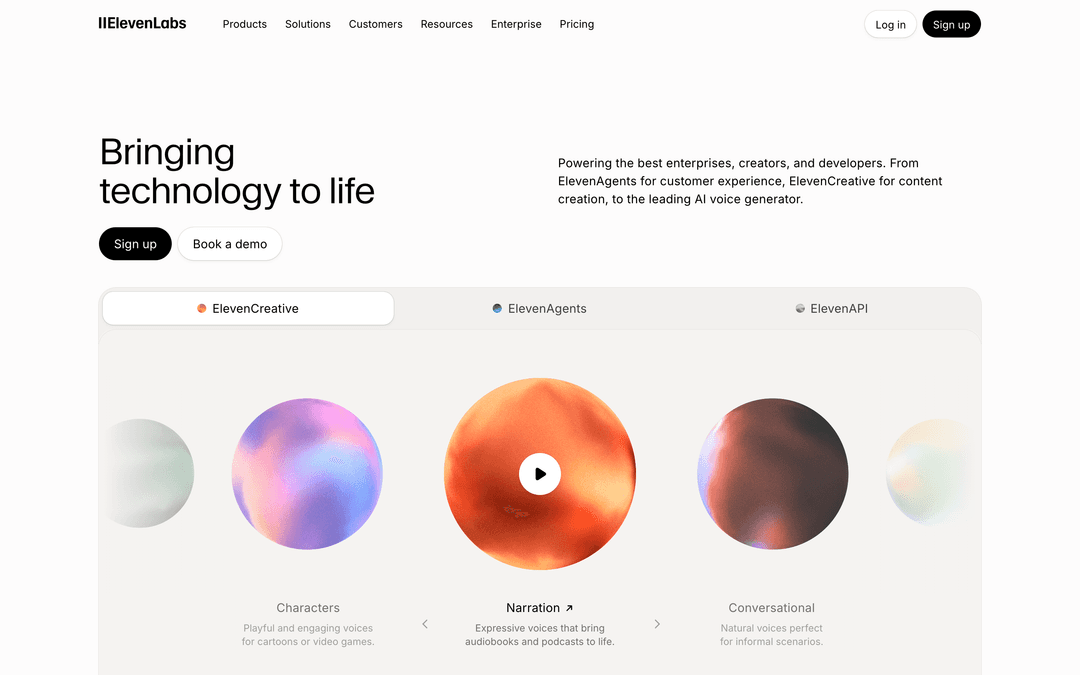
ElevenLabs turns text into speech that sounds like a person rather than a announcer. It started as a text-to-speech tool and grew into a full audio platform: narration, voice cloning, dubbing into other languages, transcription, conversational voice agents and music generation all sit under the same account and the same API.
The reason it took over the category is narrow and specific — prosody. Most speech synthesis gets the words right and the delivery wrong: correct pronunciation, flat rhythm, emphasis in the wrong place. ElevenLabs handles pauses, emphasis and emotional register well enough that listeners usually stop noticing they are hearing a machine. That is the whole product.
Picking the right model matters more than any other setting, because the models trade quality against latency in opposite directions. There is no single best one — there is the right one for narration and the right one for a live conversation.
The flagship speech model, generally available since February 2026. It supports over 70 languages, handles multi-speaker dialogue, and understands inline audio tags such as [laughs], [whispering] or [sarcastic] that let you direct the performance from inside the script. The catch is that v3 is not a real-time model, so it belongs in production work — audiobooks, video narration, character voices — rather than in a live agent.
Emotionally rich and consistent across 29 languages. It predates v3 and remains a sensible default for professional content where you want predictable output and do not need the theatrical range or the wider language coverage.
Roughly 75ms latency across 32 languages, at about half the cost per character of the higher-quality models. This is the model for voice agents and anything interactive, where a delay is far more damaging than a slightly less nuanced reading. (Turbo v2.5 is functionally equivalent but slower on average; ElevenLabs recommends Flash over Turbo in every case.)
Transcription in more than 90 languages with speaker diarization, meaning it labels who said what rather than producing an undifferentiated wall of text. A realtime variant runs at roughly 150ms for live captioning and meeting transcription.
Produces studio-grade instrumental and vocal tracks from a plain-language prompt. It is the newest limb of the platform and the least central, but it closes the loop for anyone scoring a video who does not want to license a stock track.
| Model | Purpose | Latency | Languages |
|---|---|---|---|
| Eleven v3 | Most expressive speech, audio tags, dialogue | Not real-time | 70+ |
| Multilingual v2 | Professional narration, predictable output | Standard | 29 |
| Flash v2.5 | Voice agents, interactive apps | ~75 ms | 32 |
| Scribe v2 | Transcription with speaker labels | Standard | 90+ |
| Scribe v2 Realtime | Live captions and meetings | ~150 ms | 90+ |
| Eleven Music v2 | Music from text prompts | Not real-time | Multiple |
The core use case: paste a script, choose a voice, get a finished read. It covers YouTube narration, e-learning modules, audiobooks, podcast inserts and ad reads. For longer projects the Studio interface handles multi-chapter documents rather than making you generate one paragraph at a time.
Two levels. Instant Voice Cloning builds a usable copy from a short sample and is available from the Starter plan. Professional Voice Cloning trains on a much longer recording — typically dictated by how much clean audio you can supply — and produces a far closer match; it requires Creator or above. Creators most often clone their own voice to scale narration without recording every script.
Dubbing takes existing video or audio and reproduces it in another language while preserving the original speaker's vocal identity. The result sounds like the same person speaking a language they do not speak. For anyone with a back catalogue of content, this is the feature that turns one library into several.
Scribe converts recordings into text with speaker labels attached. Useful for interviews, meetings and subtitle generation — and it is the natural other half of dubbing, since you generally need an accurate transcript before you translate anything.
The agents platform combines speech-to-text, a language model and low-latency speech into a system that holds a spoken conversation — support lines, booking flows, interactive characters. This is where Flash v2.5 earns its place: the difference between 75ms and half a second is the difference between a conversation and an interrogation.
Cloning your own voice is straightforward. Cloning somebody else's is a legal question before it is a technical one, and it is worth being blunt about it.
ElevenLabs' terms require that you own the voice or have the speaker's consent. Separately, a growing number of US states have enacted voice-cloning and right-of-publicity laws, and similar rules are appearing elsewhere. Paying for a plan unlocks the feature; it does not grant you the right to clone a particular person. If the voice is not yours, get documented permission — that is the entire safeguard, and it is on you rather than on the platform.
Narration without a microphone, a treated room or a re-record every time the script changes. Editing a sentence costs seconds instead of another recording session.
Course modules and audiobooks at volume, where hiring voice talent for every update is not economic. Consistency across hundreds of files matters more here than a standout performance.
Dubbing plus transcription turns a single-language library into a multilingual one without recasting each market. The retained vocal identity is what makes it feel like a translation rather than a replacement.
Voice agents for phone support, booking and triage, built on the low-latency models and wired into existing systems through the API.
The API and SDKs are the reason a lot of applications sound the way they do — voice is a feature bolted onto someone else's product far more often than it is a destination in itself.
Plans are metered in credits, which are consumed by every kind of generation — speech, dubbing, transcription, music. Higher-quality models burn credits faster than Flash, so your effective cost depends as much on model choice as on volume. Annual billing is charged for ten months instead of twelve, which works out to two months free.
| Plan | Monthly | Annual (per month) | Credits / Month | Notable |
|---|---|---|---|---|
| Free | $0 | — | 10,000 | No commercial use, attribution required |
| Starter | $6 | $5 | 30,000 | Commercial rights, instant voice cloning |
| Creator | $22 | $18.33 | 121,000 | Professional voice cloning |
| Pro | $99 | $82.50 | 600,000 | Higher volume, production work |
| Scale | $299 | $249.17 | 1,800,000 | Teams and large libraries |
| Business | $990 | $825 | 6,000,000 | Enterprise-scale usage |
This is the detail worth knowing before you build anything on it. The free plan gives you 10,000 credits a month, but it carries no commercial usage rights and requires visible attribution to ElevenLabs in anything you publish. Instant voice cloning is not included either. It is genuinely useful for evaluating quality — and unusable for client work, monetised video or a shipped product.
Audio you generated while on a paid plan keeps its commercial rights permanently, including after you stop subscribing. You are licensing the generation, not renting the output, which matters if you are producing a library over a short paid period.
There is a free plan with 10,000 credits a month, but it does not include commercial usage rights and requires attribution to ElevenLabs. For any paid or published work you need at least the Starter plan at $6 per month.
Use Eleven v3 for narration, character work and anything where delivery matters. Use Flash v2.5 for voice agents and interactive applications where latency matters more than nuance. Multilingual v2 remains a solid middle option for predictable professional output.
It depends on the model rather than the platform. Eleven v3 covers over 70 languages, Flash v2.5 covers 32, Multilingual v2 covers 29, and Scribe transcription covers more than 90.
Yes. Instant Voice Cloning works from a short sample and is available from the Starter plan upward. Professional Voice Cloning needs a longer recording and the Creator plan or above, and produces a noticeably closer match.
Only with their consent. ElevenLabs requires that you own the voice or have permission, and voice-cloning laws in a number of jurisdictions apply on top of that. The subscription unlocks the capability, not the right.
Yes. Audio generated while you were on a paid plan retains its commercial rights after cancellation.
Yes. Scribe handles transcription with speaker labels in 90+ languages, and the dubbing feature reproduces existing audio in another language while preserving the original speaker's vocal identity.
ElevenLabs is the default choice for AI speech, and it earned that position on delivery rather than marketing — it gets rhythm and emphasis right often enough that the output holds up in published work. The platform has since widened into dubbing, transcription, agents and music, which makes it a reasonable single vendor for anything audio.
The things to plan around are the credit model, the split between expressive and real-time models, and a free tier that is strictly an evaluation sandbox. If you are producing narration at volume, localising a back catalogue or putting a voice on a product, this is the tool to beat.