Isaac
AI-Powered Academic Writing Assistant
Ask a research question and get answers built from real papers with citations. Consensus Meter, Deep Search literature reviews and Medical mode. Free tier, Pro from $12/month.
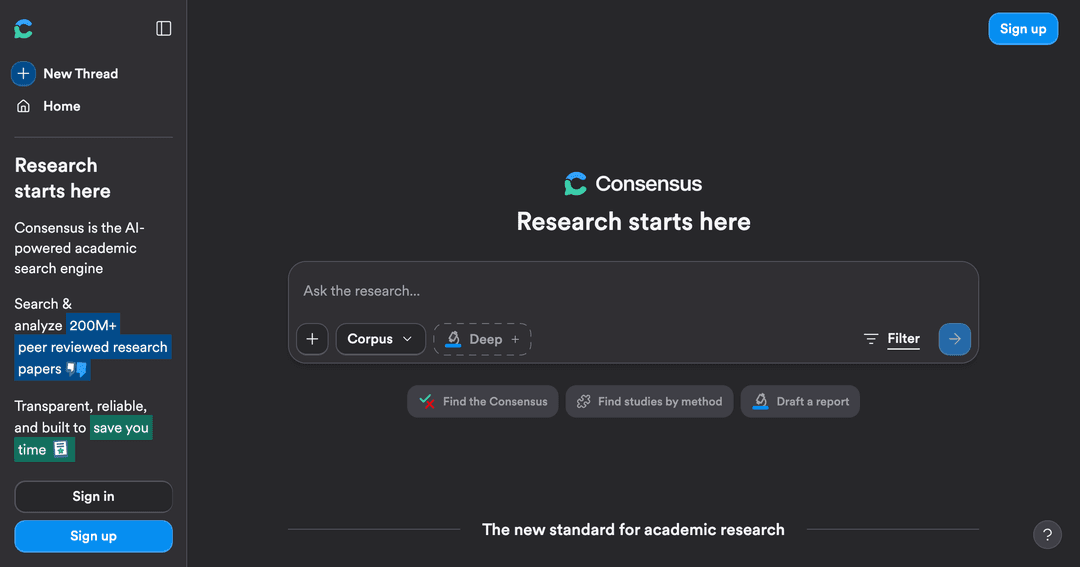
Consensus is a search engine for scientific literature that answers questions instead of returning a list of links. Ask whether creatine improves cognitive performance and you get a synthesised answer assembled from actual papers, each claim attached to the study it came from. It draws on more than 250 million research papers, including licensed full text from major publishers.
The distinction from a general chatbot is the whole point. A language model asked about creatine produces plausible sentences from training data, and the citations it offers may not exist. Consensus starts from the literature: it retrieves papers first, then summarises what they found. If a claim has no paper behind it, it does not appear.
That design has earned it institutional trust — over 170 university libraries provide access to students and faculty, and the company reports around 10 million users.
The signature feature and the reason people remember the name. Ask a clear yes-or-no research question and you get a visual read on how much the retrieved evidence agrees, disagrees or is uncertain — the state of a field in a glance rather than an afternoon.
It is genuinely useful and worth understanding precisely, because it is easy to over-read. The meter shows agreement among the papers Consensus retrieved. It is not a verdict on truth, it does not weigh a large randomised trial against a small observational study, and a field where every paper agrees may simply be a field where contrary results were never published. Treat it as a map of the literature, not a ruling on the science.
It also only works on questions with a yes-or-no shape. «Does X cause Y» gets a meter; «how has X evolved since the 1990s» does not, and should not.
Deep Search is the feature the pricing is built around. Rather than answering from the first handful of relevant papers, it builds a search strategy the way a researcher would: expanding key terms, deliberately hunting for conflicting arguments, and following the citation graph outward.
The output is a broad, structured review of a question across a large body of work. It is aimed at the kind of task that genuinely takes days — mapping what a field agrees and disagrees on before you write a word. It is not a systematic review and should not be presented as one, but it covers ground that used to require a fortnight of database queries.
Deep reviews are metered on every plan, which makes them the number to check when choosing a tier.
A filter that narrows results to roughly 50,000 clinical guidelines and 8 million articles from the top 1,000 medical journals. For clinical questions this changes the answer quality substantially: general search across 250 million papers surfaces preprints and marginal journals alongside guidance, while Medical mode restricts the pool to sources a clinician would actually cite.
This is also the feature that makes the subscription defensible for a practising clinician, where the alternative is manual guideline lookup between patients.
Timeframes, populations and study designs can be stated in the question itself — research before and after 2020, or the strongest population-level evidence — and Consensus applies the corresponding filters. Small feature, large effect: it removes the step where a good question gets mangled into database syntax.
Three individual tiers plus team plans. Annual billing takes 40% off, which is a large enough gap that the monthly price is worth treating as the trial rate.
| Plan | Monthly | Annual (per month) | Pro messages | Deep reviews | API & MCP |
|---|---|---|---|---|---|
| Free | $0 | $0 | 15 per month | Up to 3 per month | — |
| Pro | $20 | $12 | Unlimited | 15 per month | 250 uses/mo |
| Deep | $65 | $45 | Unlimited | 200 per month | 1,000 uses/mo |
| Teams | $30/seat | — | Unlimited | 50 per month | On approval |
Read the free tier carefully, because it is more generous than it first looks and more limited than it sounds. Basic paper search is unrestricted; the AI analysis is not. Fifteen Pro messages a month is a few sessions, and three Deep reviews is enough to understand what the feature does. For an occasional question it genuinely suffices.
Pro is the tier for anyone doing this weekly: unlimited analysis and fifteen Deep reviews a month covers a dissertation chapter or a steady research habit. Deep at $45 a month on annual billing exists for people running literature reviews constantly — its 200 reviews are roughly seven a day, which is a working pattern rather than an occasional need.
One discount matters more than the plan choice: students and faculty with a school email, and US healthcare professionals with an NPI number, get up to 40% off. Stacked with annual billing that is the cheapest route by a wide margin.
Both paid individual tiers include API and MCP usage — 250 requests a month on Pro, 1,000 on Deep, then $0.10 per request up to a cap. The MCP part is the interesting one: it lets an AI assistant query the literature directly, so a research agent can cite real papers rather than inventing them. That is an unusual thing to include in a $12 subscription.
The core audience. Mapping a field before writing is the slowest part of any thesis, and Deep Search compresses it hardest. With the student discount, the annual cost is smaller than a single textbook.
Medical mode and its guideline pool answer the practical question — what does current evidence recommend — faster than any general search. US healthcare professionals qualify for the discount.
Anyone who has to write accurately about a scientific claim under deadline. The Consensus Meter answers the question that actually matters for a story — is this a settled finding or a contested one — in seconds.
API and MCP access on a normal subscription makes this a cheap way to give an assistant real literature grounding, without an enterprise contract.
Yes, with limits. Basic paper search is free and unrestricted; the AI analysis is capped at 15 Pro messages and up to 3 Deep reviews a month. Pro costs $20 monthly or $12 a month billed annually.
It works from retrieved papers rather than generating references, so the fabricated-citation problem of general chatbots does not apply in the same way. Summaries can still misrepresent a paper's nuance, so check anything you intend to cite.
No. It shows how much the retrieved papers agree. It does not weigh study quality, and agreement in a literature can reflect publication bias as easily as settled science.
No. Deep Search does adjacent work — broad coverage, conflicting-evidence detection, citation graph exploration — but a systematic review has protocol and screening requirements this does not meet.
Up to 40% off for students and faculty with a valid school email, and for US healthcare professionals with an NPI number.
Possibly. More than 170 university libraries partner with Consensus to provide access. Check with your library before paying personally.
Consensus does the one thing general AI assistants cannot be trusted with: answering a factual question from the scientific record, with the papers attached. For anyone whose work depends on being right about what the research says, that difference is the entire value, and the free tier is enough to feel it.
Use it with its limits in view. The meter maps agreement rather than truth, summaries lose the caveats that often matter most, and nothing here removes the obligation to read a paper before citing it. What it removes is the week you would have spent finding which papers to read — and if you are a student or a clinician, the discount makes that trade close to free.