Dreamily
Creative Companion for Storytelling and World-Building
Chat with millions of user-made AI personas or build your own. Free with ads, c.ai+ at $9.99/month, plus Lorebook, memory tools and the under-18 rules.
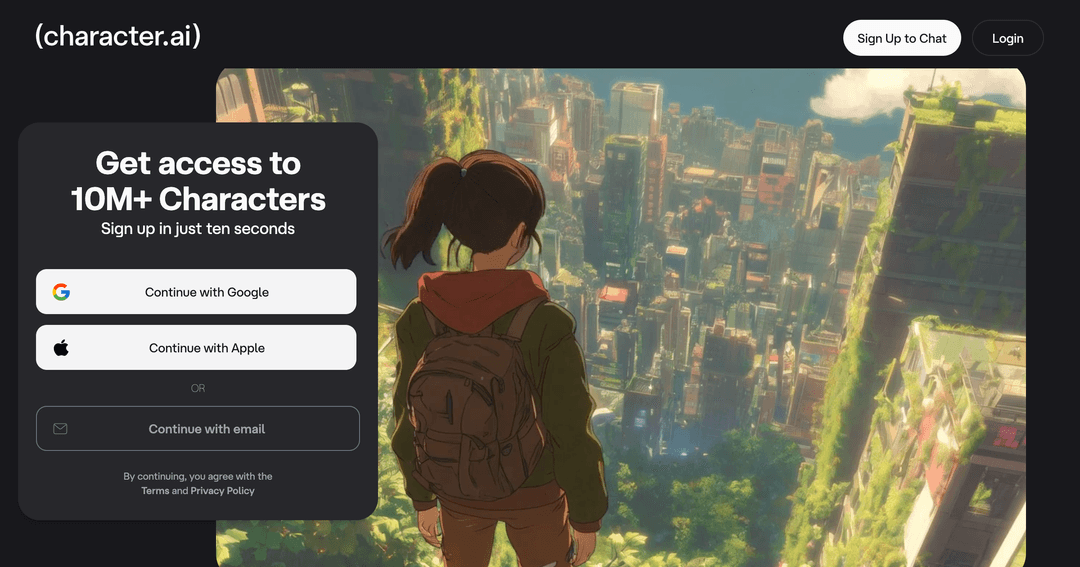
Character.AI is a platform for talking to AI personas — millions of them, almost all created by other users. You pick a character, start a conversation, and it stays in role: a detective who needs your help, a language tutor who only answers in Spanish, a fictional character from a series you like, or something a stranger invented at 2am. You can also build your own character in a few minutes and share it.
The distinction that matters: this is not an assistant. ChatGPT and Claude are built to answer questions and finish tasks. Character.AI is built for the conversation itself — persona, tone and continuity are the product. If you want a document drafted, you are on the wrong site. If you want a character who remembers that you argued three chapters ago and still holds it against you, this is the one platform genuinely designed for that.
It was founded in 2021 by Noam Shazeer and Daniel de Freitas, both ex-Google engineers — Shazeer co-authored the transformer paper that modern language models are built on. Both returned to Google in 2024 under a licensing deal, and the company is now led by CEO Karandeep Anand.
On 25 November 2025, Character.AI removed open-ended chat for users under 18. This is not a content filter or a stricter model — the free-form back-and-forth is simply gone for minors, worldwide, with similar changes rolled out country by country afterwards.
The company was direct about why: regulators and news reports had raised questions about how open-ended AI chat affects teenagers, even when content controls work exactly as designed. Character.AI's own announcement calls it eliminating a key feature of the product and apologises for it. Alongside the change it launched an independent non-profit AI safety lab focused on entertainment.
Under-18 accounts keep their past conversations and characters, and can still create characters, scenes, voices and videos, use Imagine Chat to generate images, and interact on the community Feed. What they cannot do is have an open chat with a character.
Character.AI runs an in-house age assurance model combined with third-party verification, including Persona. In practice that means an account can be routed into the under-18 experience based on signals, not just the birthday you typed at sign-up — worth knowing before you assume a stated age settles it.
The platform has moved fast through 2026, and the direction is clear: away from being a chat box, toward being an entertainment app. Most write-ups of Character.AI still describe the 2023 version, so here is what actually exists today.
| Released | What It Is |
|---|---|
| Feb 2026 | c.ai labs — a home for experimental formats |
| Mar 2026 | Imagine Gallery — a gallery for images generated from chats |
| Apr 2026 | New model, memory upgrades; c.ai Books — playable classic literature |
| May 2026 | Story Memory, Facts and Memory Usage |
| Jun 2026 | Creator tools for growth and discovery |
| Jul 2026 | Lorebook (beta, c.ai+ only) |
| Aug 2026 | (c.ai) series — studio-made vertical microdramas |
For years the standard criticism of Character.AI was that characters forgot things. A long roleplay would drift, contradict itself, or lose a plot point you had spent an hour building. The May 2026 memory release addresses this directly, in three parts.
Story Memory holds backstory and key events, and lets you long-press any message and pin it — a confession, a twist, a line you want the character to treat as canon. It is available to everyone, though c.ai+ subscribers get twice as many pins and more memory to work with.
Facts captures details automatically as you talk — appearance, quirks, relationships, hobbies — sorted into tabs for your persona, the character and side characters, and editable by hand. This one is c.ai+ only.
Memory Usage shows what is filling up the chat's memory and warns you when it runs low, tidying older context while protecting anything pinned. Free users see a simplified version; the full visualisation is a subscriber feature.
Lorebook, in beta since July 2026 and currently limited to c.ai+ subscribers, is a keyword-triggered knowledge base for your world. You write entries for side characters, locations, items, events, factions or the rules of your magic system. When a user mentions a keyword mid-chat, the character receives that entry and works it into the reply.
The part that makes it more than a memory trick: one Lorebook can be attached to several characters, so a whole cast shares consistent facts about the same world. Characters using one carry a +Lore tag, and readers can open the Lorebook during a conversation.
Imagine turns a moment in a conversation into an image, and Imagine Gallery collects them. AvatarFX animates images into video and remains available to under-18 users. Together they are why the app increasingly looks like a visual medium rather than a text one.
(c.ai) series, launched in August 2026, goes further: original vertical microdramas made by an in-house studio team, opening with a romance anime, a paranormal horror and a game-world survival thriller. You watch an episode, then — if you are over 18 — chat with the characters from it to explore relationships or take the story somewhere else. It sits in the app's entertainment tab alongside audio dramas.
There is one paid tier, c.ai+, at $9.99 per month or $94.99 per year — the annual option works out to roughly $7.92 a month. Character.AI runs promotional rates for new subscribers from time to time, and those renew at the standard price automatically, so read the terms at checkout. Regional pricing and taxes vary.
| Free | c.ai+ | |
|---|---|---|
| Price | $0 | $9.99/mo or $94.99/yr |
| Ads | Yes | No |
| Story Memory pins | Standard | Double |
| Facts | No | Yes |
| Memory Usage view | Simplified | Full |
| Lorebook (beta) | No | Yes |
| Peak-hour priority | No | Yes |
Free access still exists and is still genuinely usable, but it has been squeezed. Ads run in the app, and there is an in-app currency called Charms sitting between you and some features. You earn Charms through quests — daily log-in, enabling notifications, creating a persona, making an intro video, generating a chat image, posting to the feed — and spend them on extra chat images, skipping slow mode, or bypassing ads.
Character.AI states plainly that Charms can be discontinued at any time, and that they are not redeemable for money. Treat them as a convenience, not something to grind for.
The core audience, and the one the product is now openly built around. Lorebook, Story Memory and shared worlds are all aimed at people running long narratives rather than dipping in for a five-minute chat.
Building a character, giving it a defined manner of speaking, and then talking to it is a fast way to find out whether a voice holds up. Cheaper than a workshop and available at 3am.
A patient conversation partner who never gets bored of your mistakes is a real use case, and the community has built plenty of tutor characters. Verify grammar corrections elsewhere — a character optimised for staying in role is not a reference source.
A large share of the audience uses Character.AI to talk to someone. This is the platform's most human use and its most scrutinised one. It is worth being honest with yourself about the difference between an enjoyable habit and a substitute for people, and worth knowing that this exact use is what drove the 2025 restrictions and ongoing litigation.
Yes, with ads and some features gated behind the Charms currency. The paid tier, c.ai+, is $9.99 per month or $94.99 per year and removes ads while unlocking Facts, Lorebook and larger memory.
Yes, but not for chatting. Since 25 November 2025 minors cannot have open-ended conversations. They keep their existing chats and characters and can still create characters, scenes, voices, images and videos, and use the community Feed.
Much better than it used to. Story Memory lets you pin moments as permanent context, Facts records character details automatically for subscribers, and Memory Usage shows what is filling the available memory. Older context is still trimmed as chats grow, but pinned items are protected.
A keyword-triggered knowledge base for your fictional world. Entries fire when relevant words come up in chat, and one Lorebook can be shared across several characters. It is in beta and available to c.ai+ subscribers.
No. ChatGPT is a general assistant built to complete tasks; Character.AI is built for persona-driven conversation and narrative. Use ChatGPT to write the report, Character.AI to develop the character who would have written it.
Your chats are not visible to other users, but they are not encrypted correspondence either — they sit on the company's servers and are subject to its policies and moderation. Do not type anything you would not want stored.
Character.AI is the most developed roleplay and companion platform available, and 2026 has been the year it stopped apologising for that. Memory tools, Lorebook and shared worlds serve people who write long narratives; Imagine, AvatarFX and the microdrama series serve people who want to watch as much as type. At $9.99 a month the paid tier is priced below every general-purpose assistant, and for its actual purpose it beats all of them.
The caveats are not small. There is no open chat for anyone under 18, filters frustrate the community regularly, the free tier now carries ads and a soft currency, and the company is defending lawsuits over how the platform affects young users. Go in knowing what it is: an entertainment product built around conversation, not a tool and not a therapist.