Kaedim
Generador de modelos 3D con IA para diseño de juegos y productos
GET3D es el modelo de IA de NVIDIA que genera mallas 3D detalladas y texturizadas directamente a partir de imágenes 2D. Ideal para juegos, animación y creación de mundos virtuales, sin necesidad de escanear 3D.
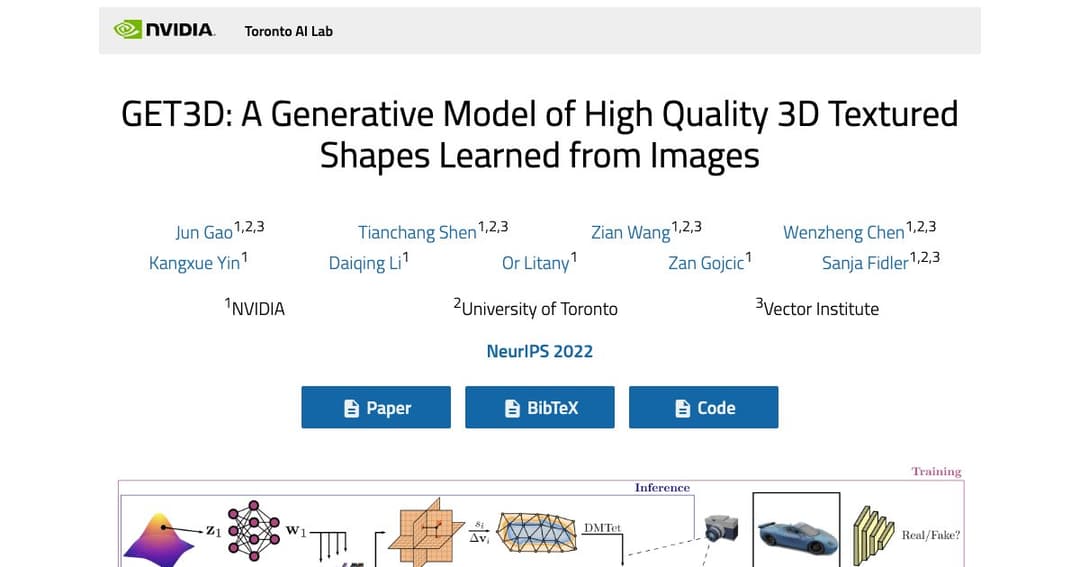
GET3D es un modelo generativo avanzado desarrollado por NVIDIA que crea mallas 3D texturizadas de alta calidad directamente a partir de colecciones de imágenes 2D. A diferencia de los procesos de modelado 3D tradicionales que requieren escaneos, sensores o herramientas CAD, GET3D aprovecha el aprendizaje profundo para generar objetos 3D complejos, listos para usar en animación, videojuegos y producción virtual.
Entrenado mediante aprendizaje adversarial y renderizado diferenciable, GET3D puede producir diversos objetos con texturas y geometría realistas. Genera mallas de alta fidelidad, topología arbitraria y detalles de materiales intrincados, acortando la distancia entre la IA y los recursos 3D listos para producción.
GET3D genera dos códigos latentes distintos: uno para la forma (geometría) y otro para la textura. Estos se utilizan para generar un campo de distancia con signo (SDF) y un campo de textura que definen la malla 3D y la apariencia de la superficie.
Utilizando DMTet (Tetraedros de Marcha Profunda), GET3D convierte el SDF en una malla triangular. A continuación, consulta el campo de textura para pintar la malla con características detalladas de color y material.
GET3D se entrena con imágenes 2D y siluetas con pérdidas adversarias. El renderizado diferenciable permite que el modelo retropropague errores del espacio de la imagen al espacio 3D, lo que facilita el aprendizaje sin supervisión 3D explícita.
GET3D genera objetos 3D texturizados con detalles finos como faros, costuras, pelaje y reflejos, lo que lo hace adecuado para tareas de animación y simulación.
A diferencia de muchos modelos anteriores, GET3D puede generar formas complejas y no rígidas en una amplia gama de categorías, incluidos animales, vehículos, muebles, zapatos y avatares humanos.
GET3D separa la geometría y la textura en códigos latentes distintos. Los usuarios pueden manipular ambos aspectos de forma independiente para lograr un mayor control en la generación de recursos.
Al interpolar entre vectores latentes, GET3D permite transiciones suaves y la transformación entre formas y texturas. Esta función es útil para la animación, la variación de recursos y la iteración del diseño.
Al incorporar la pérdida direccional basada en CLIP (como se observa en StyleGAN-NADA), GET3D permite la generación de formas guiada por texto. Los usuarios pueden ajustar los resultados mediante indicaciones en lenguaje natural para un control creativo.
Cuando se combina con DIBR++ (un renderizador híbrido), GET3D también puede simular materiales y efectos de iluminación de forma no supervisada, mejorando el realismo en los renders.
Los desarrolladores de juegos pueden generar rápidamente modelos de personajes, accesorios y entornos con geometría y textura consistentes, lo que reduce significativamente el tiempo de modelado manual.
GET3D permite la creación rápida de prototipos de activos estilizados o fotorrealistas con variación de diseño flexible y exportación directa a canales de renderizado.
Ideal para creadores de realidad virtual, GET3D proporciona una forma escalable de poblar espacios virtuales con contenido 3D de alta calidad, sin necesidad de escaneo o modelado tradicionales.
Los minoristas y diseñadores industriales pueden utilizar GET3D para visualizar productos en 3D a partir de imágenes del catálogo, mejorando los flujos de trabajo de simulación y compras interactivas.
GET3D es el resultado de una investigación colaborativa entre NVIDIA, la Universidad de Toronto y el Vector Institute, presentada en NeurIPS 2022. Se basa en trabajos previos como DMtet, EG3D y DIBR++, avanzando aún más en el modelado generativo 3D.